Knowledge graph search interprets query terms as entities, then ranks those entities and their relationships against similar entities in an index. It complements lexical search and dense vector search when query concepts can be identified. section 7.1
A query-interpretation pipeline can combine three matching approaches:
- Lexical search uses Boolean matches in an inverted index, commonly with BM25 ranking. section 7.1
- Knowledge graph search compares recognized entities and their relationships with entities in a semantic or explicitly built knowledge graph. section 7.1
- Dense vector search uses cosine similarity and approximate-nearest-neighbor retrieval over embeddings. section 7.1
Query interpretation pipeline
For “bbq near atlanta,” entity extraction identifies known keywords and locations, signals boosting promotes popular documents for the query, and later stages apply matching with fallback handling. section 7.1
Figure 7.1 An example query interpretation pipeline
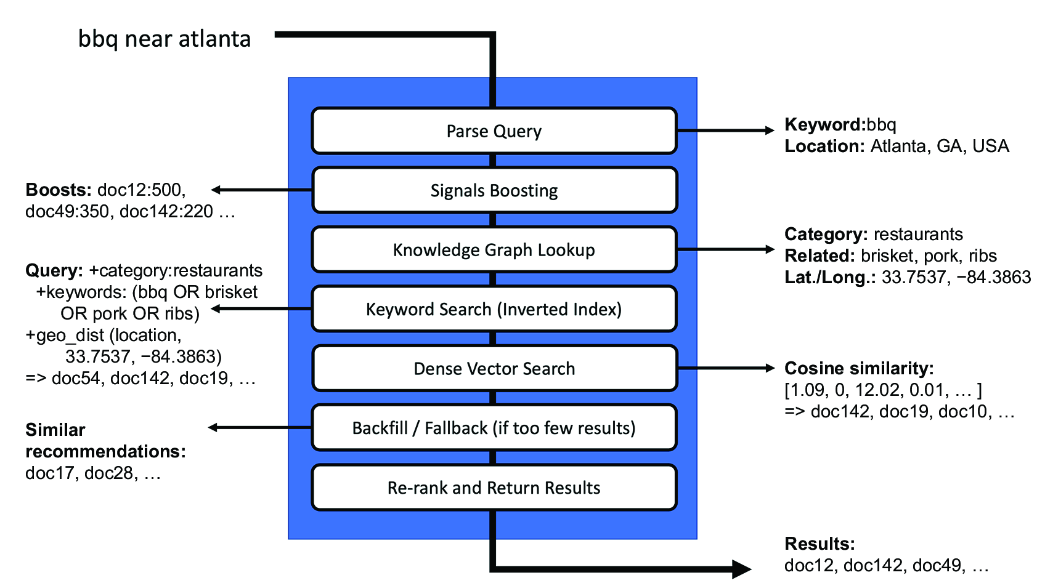
Follow the pipeline from query parsing through entity extraction, signals boosting, matching, and fallback behavior. section 7.1
