Personalized relevance ranks items according to what a particular user is likely to find relevant, rather than what most users prefer overall. In search and recommendation systems, it is commonly implemented through collaborative filtering: user interactions provide signals from which preferences and relationships can be inferred. section 4.2.3 section 4.0
A collaborative-filtering feedback loop typically:
- Collects positive interactions such as clicks, purchases, and ratings. section 4.2.3
- Builds a user-item interaction matrix whose relationship strengths reflect those interactions. section 4.2.3
- Finds users who interacted with the same item and boosts other items those users also interacted with. section 4.2.3
- Logs responses to recommendations as new signals, allowing relevance to improve continuously. section 4.2.3 section 4.3
Shared interaction patterns
Suppose a user has interacted with one item. Other users who interacted with that same item provide evidence for additional recommendations; items they also interacted with can be boosted for the original user. When the matrix is too sparse for direct comparisons, matrix factorization represents users and items through shared latent features. section 4.2.3
Figure 4.6 Collaborative filtering for user-to-item recommendations. Based upon his past behavior, our user (Alonzo) receives recommendations based on items other users liked, where those users also interacted with some of the same items as Alonzo.
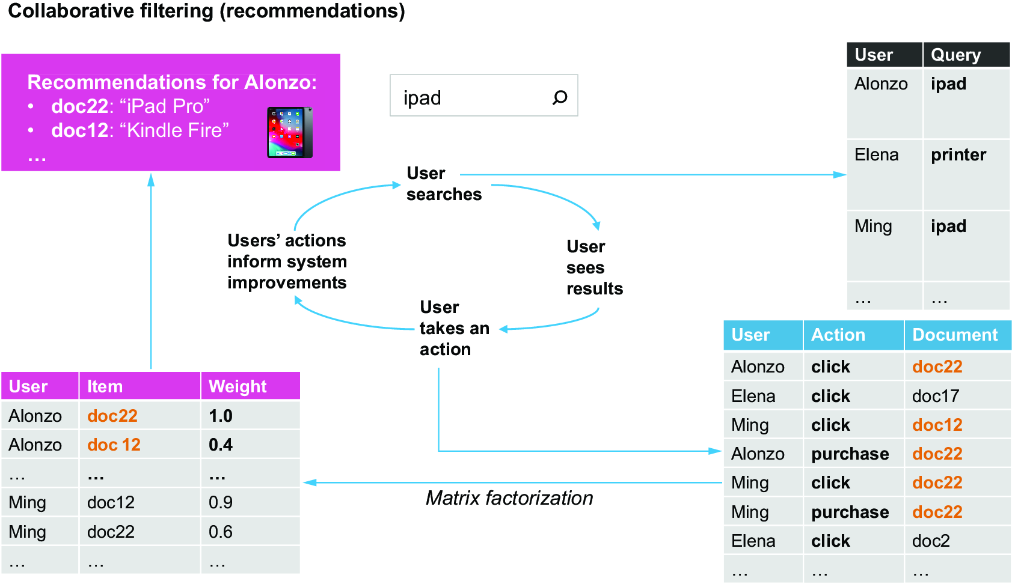
Use the collaborative-filtering diagram to trace how a user's past behavior connects to similar users, shared items, and new recommendations. section 4.2.3
