Imagine predicting graduate admission by asking one question at a time. A greedy decision tree chooses the strongest available feature or split at each node, then continues from there. The locally strongest choice may not produce the best complete tree. section 9.5
The strategy works like this:
- Choose the top feature at the current node. section 9.5
- Split the data and repeat the choice within each resulting branch. section 9.5
- Inspect the resulting tree without discarding features absent from it; individually weak features may form a strong combination. section 9.5
Student admissions
In an admissions tree, CGPA becomes the root feature, followed by GRE and TOEFL scores. Statement-of-purpose strength appears later and changes predictions little. A different combination of features might nevertheless be valuable. section 9.5
Figure 9.24 A decision tree of depth 3 trained in the student admissions dataset
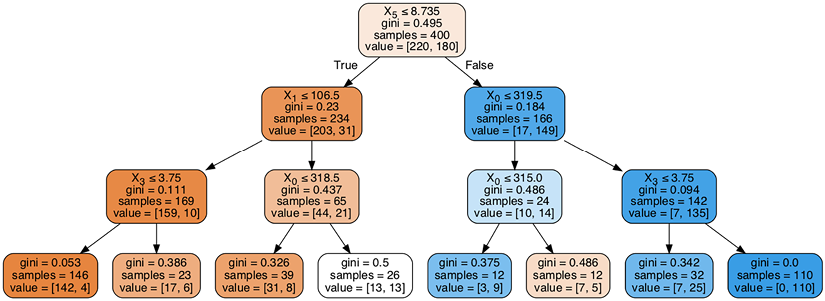
Inspect a depth-three admissions tree to see how locally selected features organize the branches. section 9.5
