Cognitive debt is the growing difficulty of maintaining code that works but that developers do not fully understand or own. AI-generated code can add hidden assumptions: implementation choices may be plausible yet unfamiliar, making debugging, modification, and failure prediction harder. section 4.3.3
A caching change
An AI adds caching to an API endpoint. Weeks later, production slows because the caching logic has a subtle race condition. Debugging then means untangling code and decisions the developer did not make. section 4.3.3
The debt can compound across features. Different AI-generated implementations may use different error-handling, logging, and validation patterns; each can work alone while making the codebase harder to navigate and maintain. section 4.3.3
Figure 4.6 Without defined standards, each AI-generated feature adopts different patterns, creating a maintenance burden and technical debt.
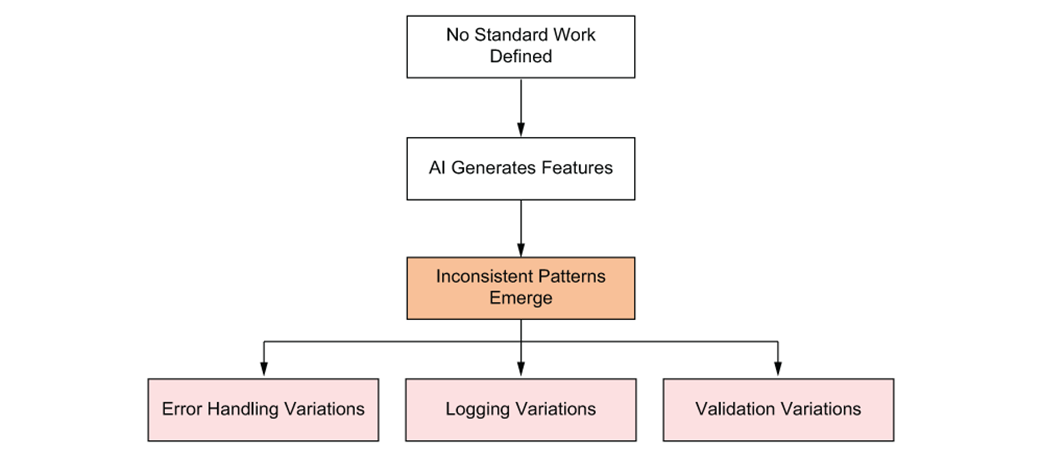
The figure illustrates how undefined standards let AI-generated features accumulate inconsistent patterns and maintenance burden. section 4.3.3
