Illumination is the moment a potentially useful idea becomes consciously apparent. It is not a magical beginning: it follows participation and incubation, and it produces a promising direction rather than a finished answer. A lightbulb moment may start work, but it still needs work behind it. section 5.2 section 7.0
Figure 5.2 The five steps of the creative process. An overabundance of arrows emphasizes the interrelatedness among the steps. Participation is usually step 1, but a sudden idea might just as well put the process in motion. Rejection is not necessarily the end, provided enough energy remains to rework the concept.
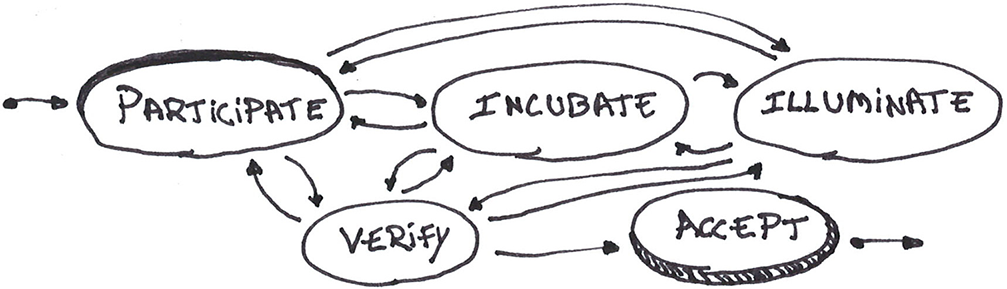
Illumination is one part of a five-stage, recursive process. Move among participation, incubation, illumination, and verification as the work demands; presentation and acceptance follow successful verification. section 5.2
Treat illumination as an actionable habit rather than a waiting game:
- Prepare first: collect clues, explore the problem, and do the unglamorous work that gives an insight something to connect. section 7.4 section 7.4.1
- Step away when stuck: interrupt preoccupation by walking, running, or doing something else, while staying ready to capture an idea. section 5.2 section 7.0
- Return to the work: try the idea, compile, run tests, inspect the result, and restart when it fails. section 5.2
- Question the glow: a sudden insight can feel truer than a reasoned one, but it deserves the same critical verification as any other idea. section 5.4.2
A bus ride is not a proof
After weeks of unsuccessful effort on a mathematical problem, Henri Poincaré took a break and encountered an idea while boarding a bus. The insight was a hint, not a complete solution: conscious analysis still had to test and develop it. Likewise, a programmer who suddenly sees a possible fix should treat it as a hypothesis to investigate, not a reason to skip verification. section 7.0 section 5.4.2
The attractive story is a lone detective suddenly seeing the whole case. The less romantic pattern is gradual: gather apparently unrelated details, alternate effort with distance, notice a possible connection, then check whether it holds. No collected dots means little to connect. section 7.4 section 7.4.1
