Group theory studies sets of elements paired with operations. When the set and operation obey four rules, they form a group—a structure used as the mathematical foundation for Diffie–Hellman key exchange and much public-key cryptography. section 5.2.1
A group requires four properties:
- Closure: operating on two elements produces another element in the same set. section 5.2.1
- Associativity: regrouping several operations does not change the result, so a(bc) equals (ab)c. section 5.2.1
- Identity: one element leaves another unchanged; in a multiplicative group, this is commonly written as 1. section 5.2.1
- Inverse: every element has a partner that combines with it to produce the identity, such as a × a⁻¹ = 1. section 5.2.1
Diffie–Hellman uses a multiplicative group, so multiplication is the chosen operation and the multiplication sign is often omitted: a × b becomes ab. section 5.2.1
Figure 5.4 The four properties of a group: closure, associativity, identity element, and inverse element.
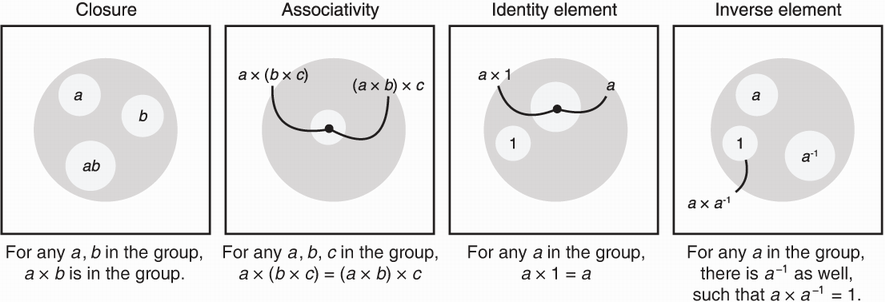
Use the visual summary to compare closure, associativity, identity, and inverse. section 5.2.1
Figure 5.5 The group of integers modulo the prime number 5 can be pictured as a clock that resets to 0 after the number 4. Thus 5 is represented as 0, 6 as 1, 7 as 2, 8 as 3, 9 as 4, 10 as 0, and so on.
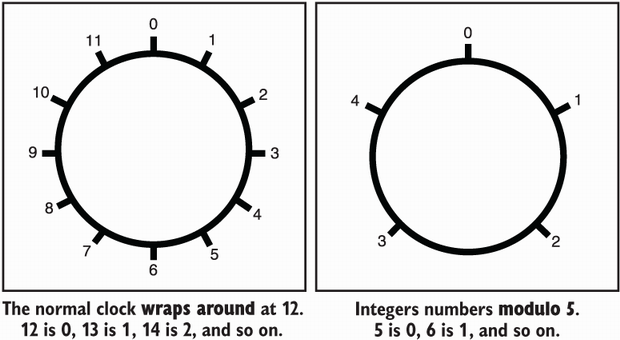
The modulo-5 clock provides a concrete picture of values resetting after 4. section 5.2.1
