In a microservice architecture, a service is an independently deployable component that implements one or more business capabilities, or subdomains. Services are loosely coupled so teams can change and deploy them with less coordination. section 1.3.1 section 7.1.1
A service has a boundary and responsibilities that shape how it collaborates with the rest of the application:
- It contains one or more subdomains and exposes an API of operations and published events. section 7.2.2
- It may invoke other services’ operations or consume their events; its database is typically private and hidden behind its API. section 7.2.2
- It is packaged as a deployable unit and has its own deployment pipeline; isolated testing helps make it production-ready independently. section 1.3.1 section 1.3.2
Order creation
An Order Service can implement order management and expose createOrder(). To reserve credit, that operation can invoke reserveCredit() on a Consumer Service. section 7.2.2
Figure 7.2 A service consists of one or more subdomains. It has an API consisting of operations and events. It collaborates with other services by invoking their operations and consuming their events.
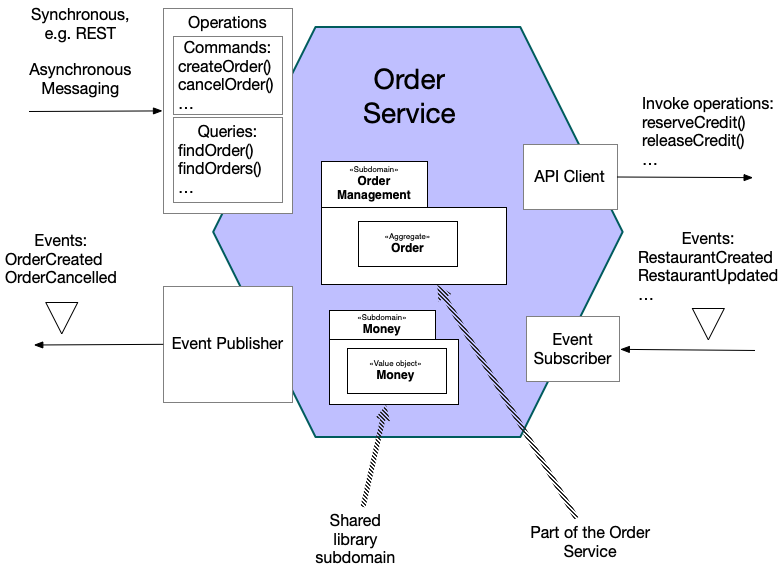
Use the diagram to see how subdomains, APIs, operations, and events fit within a service and support collaboration between services. section 7.2.2



