liveBook · Manning

Guardrails AI

As explained in Machine Learning Platform Engineering

Guardrails AI is a framework for defining and applying validators that check, constrain, and correct generative-model inputs and outputs.

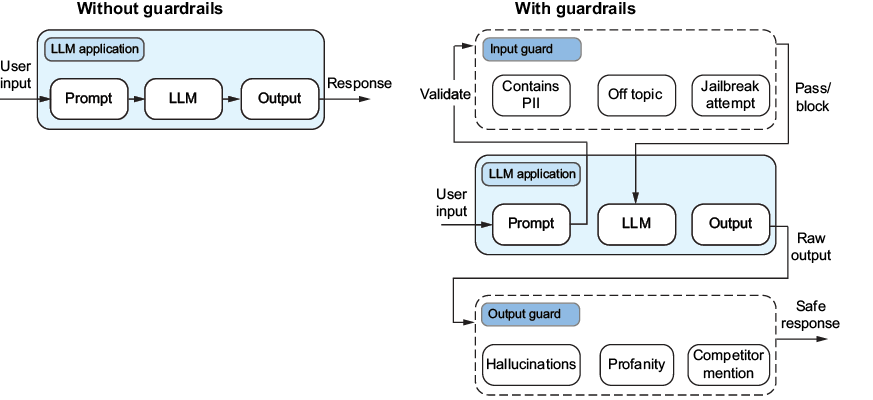
Guardrails AI applies validators around an LLM pipeline to screen user inputs, sanitize sensitive data, enforce business policies, and constrain generated outputs. Multilayer protection lets output guards catch violations that bypass input filtering. section 13.3.1

Figure 13.6 Multilayered safety guardrails architecture diagram showing input guards, LLM processing, and output guards workflow
A diagram of a diagram

AI-generated content may be incorrect.

Use the architecture as an operational pattern: validate and sanitize the request, run LLM processing, then validate the response before returning it. section 13.3.1

Validate and sanitize user input

Install validators from the Guardrails Hub, configure access, and compose them with Guard().use_many(). A competitor validator can raise an exception on detection, while GuardrailsPII can fix matching email addresses, credit-card numbers, or SSNs. Call input_guard.validate(user_input) before expensive LLM processing and return validated_output only after successful validation. section 13.3.1


How Machine Learning Platform Engineering covers it

How deep it goes
Explains the validator workflow through installation, configuration, concrete checks, failure actions, and Python integration.
Examples
Uses competitor-name detection, PII redaction, exception and fix actions, Guardrails Hub installation, and a multilayer safety diagram.
What you can do after
Apply it via the Guard API to validate, reject, or sanitize inputs before they reach a production LLM pipeline.
How it connects
Connects input validation, output validation, PII detection, prompt injection defense, business rules, and LLM processing.

Also explained in

Compare how 2 books explain Guardrails AI →

Related concepts

This explainer was generated by Manning's knowledge graph from the text of Machine Learning Platform Engineering. The section links point to the parts of the book it draws on.