A URL is a structured identifier whose parts locate a resource through a scheme, host, and optional path. A Go URL value stores these parts, while Parse converts a string into a *URL and String reassembles it. section 2.1.1
Parsing and rebuilding a URL
Given https://github.com/inancgumus, Parse produces Scheme "https", Host "github.com", and Path "inancgumus". Calling String on that value returns https://github.com/inancgumus. section 2.1.1 section 2.3.1
Implement URL handling incrementally:
- Represent the parsed value with a URL struct containing Scheme, Host, and Path string fields. section 2.1.1
- Split the raw string at the first colon to obtain the scheme and remainder; return an error when the scheme is missing. section 2.5.5
- Treat a remainder without // as an opaque URL, returning only its scheme; otherwise remove // and split the remainder into host and path. section 2.5.5
- Test Parse against expected URL values and test String against the expected reconstructed string. section 2.3.1
Parsing tests should stop with Fatalf when an error leaves no valid URL to inspect. Use Errorf for mismatches that allow the test to continue and report additional failures. The failfast flag instead stops the overall test run at its first reported failure when isolating one problem. section 2.3.1 section 2.5.5
String slicing makes the parser concise, but slicing operates on bytes. Multibyte Unicode characters can span several bytes, so careless string boundaries can split a character. section 2.5.5
Figure 2.1 The url package’s overview. Parse returns a pointer to a URL value that contains the parsed URL’s parts. String reassembles the URL value as a string.
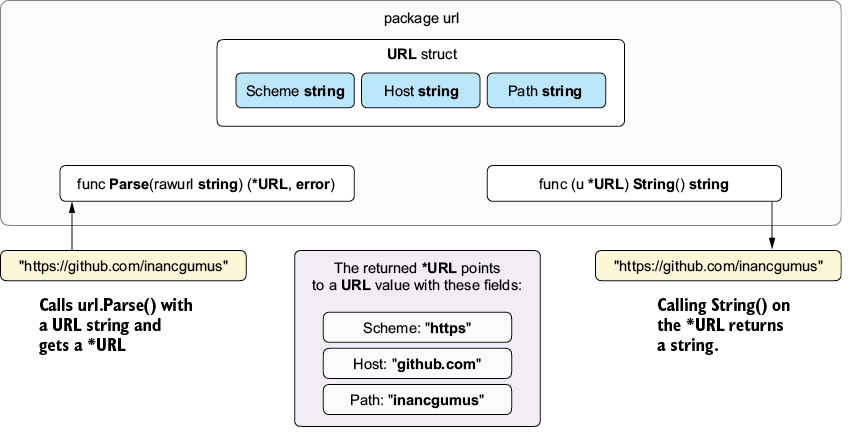
Trace how Parse returns a pointer to structured URL data and how String turns that data back into a URL string. section 2.1.1
