liveBook · Manning

Gyroid

As explained in Geometry for Programmers

A gyroid is a triply periodic minimal surface with a continuous labyrinthine structure and zero mean curvature.

A gyroid is a triply periodic minimal surface: the implicit equation sin(x)cos(y) + sin(y)cos(z) + sin(z)cos(x) = 0 repeats across all three axes. Its mean curvature is zero, so it looks globally curved while remaining locally fold-free. section 10.3.1

Gyroids are useful in 3D printing as infills and support structures. Their almost-SDF behavior provides computationally cheap control over the thickness of printed bodies. section 10.3.2

A practical gyroid workflow includes:

  • Start with the implicit gyroid equation and evaluate it across a three-dimensional grid. section 10.3.1
  • Add a parametric quasi-offset in the range (-1, 1) to make one region thicker and another thinner. section 10.3.2
  • Treat the result as an approximation rather than a true offset, because the gyroid is implicit rather than an exact signed distance function. section 10.3.2
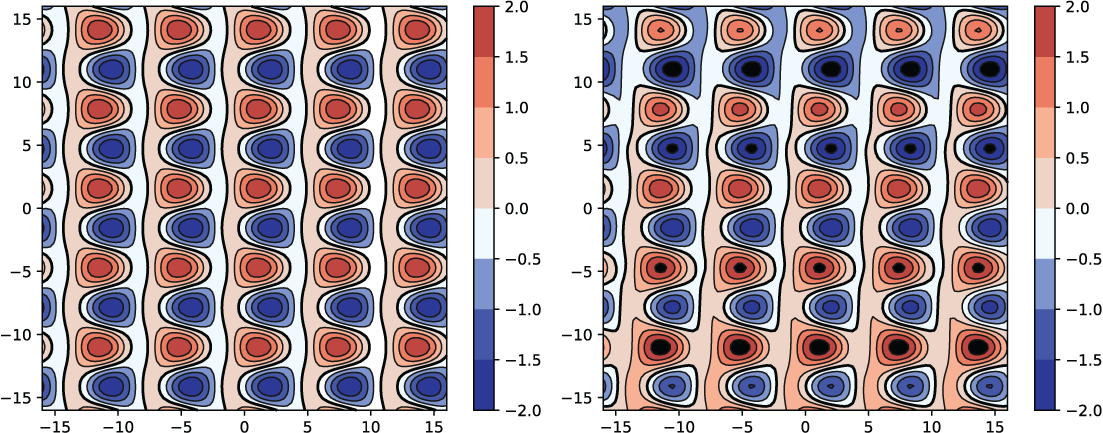
Figure 10.21 A cross section of a regular gyroid (left) and one with a parametric offset (right)
10-21

Compare a regular gyroid with one whose parametric offset changes thickness across the cross section. section 10.3.2

How Geometry for Programmers covers it

How deep it goes
Explains the implicit equation, periodicity, zero mean curvature, and approximate thickness offsets, but stops short of full curvature derivations.
Examples
Uses a trigonometric equation, printed gyroid art, variable-thickness cross sections, and a NumPy grid-evaluation listing.
What it assumes
Assumes basic familiarity with periodic functions and implicit equations while developing geometric intuition for surface curvature.
What you can do after
Build variable-thickness gyroid geometry for computational modeling and 3D-printing applications.
How it connects
Connects implicit surfaces, minimal surfaces, signed distance functions, mean curvature, infill, and support structures.

This explainer was generated by Manning's knowledge graph from the text of Geometry for Programmers. The section links point to the parts of the book it draws on.