Hard clustering assigns each data point to one cluster, or to none when the algorithm allows noise. Soft clustering instead gives points membership probabilities for groups. section 12.1.2 section 12.3
Hardness describes membership; flatness describes structure. Flat clustering keeps all clusters at one level, while hierarchical clustering builds nested groups. These are separate classification criteria. section 12.1.2
Figure 12.2 The difference between hard and soft clustering can be explained in terms of the membership function they adopt. Hard clustering’s outputs are either 0 or 1 for each point and each cluster, with the constraint that it can be 1 for only one of the point-cluster combinations. Soft clustering’s membership function outputs a probability between 0 and 1 (any value in-between) and for each point, it can be non-zero for multiple clusters.
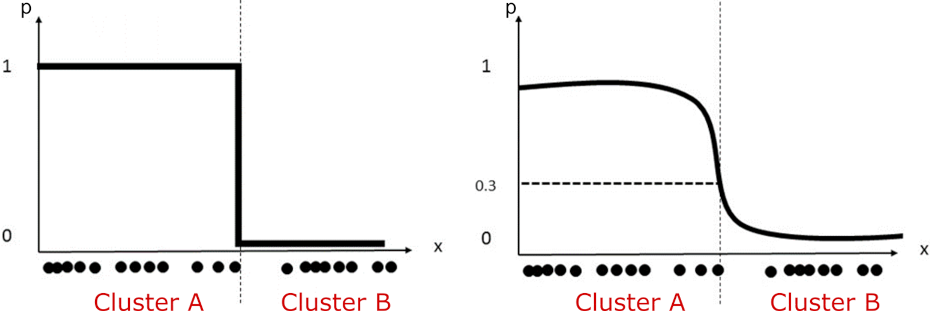
Compare the membership outputs: hard clustering allows only one cluster assignment per point; soft clustering can assign probabilities across multiple clusters. section 12.1.2
Examples show how hard clustering can pair with different strategies:
- K-means is centroid-based and flat; it works well for spherical clusters when the number of clusters can be estimated, but poorly for high-dimensional data or non-spherical clusters. section 12.1.2 section 12.2.5
- DBSCAN is density-based and flat; it can leave outliers unassigned and is considered deterministic. section 12.3 section 12.1.2

