A portfolio coordinates investments across business subdomains, initiatives, or capabilities so that prioritization and allocation reflect expected business value. In architecture modernization, it replaces a fixed target architecture with an evolutionary journey guided by investment choices. section 1.5 section 10.0
Apply portfolio thinking by varying investment according to strategic importance:
- Invest more in subdomains that strongly influence desired business outcomes, and less where a good-enough solution is sufficient. section 10.0
- Choose organizational investment as well as financial investment: team composition, collaboration, product discovery, and EventStorming may differ by subdomain. section 10.0
- Match technical ambition to value: strategic domains may justify in-house development and advanced architecture, while generic domains may favor outsourcing, off-the-shelf tools, forms over data, or low-code. section 10.0
- Review the whole portfolio for concentration and drift, such as too many high-priority domains or greater investment in supporting than core domains. section 10.3.10
Reading investment patterns
Plot subdomains on Core Domain Charts and represent investment with team size as a financial proxy. A core domain moving toward supporting may signal an approaching strategic shift; five or six core domains may indicate that priorities are spread too thinly. section 10.3.10
Figure 10.1 This chapter shows how to take a portfolio perspective and verify each candidate value stream fits into the bigger picture.
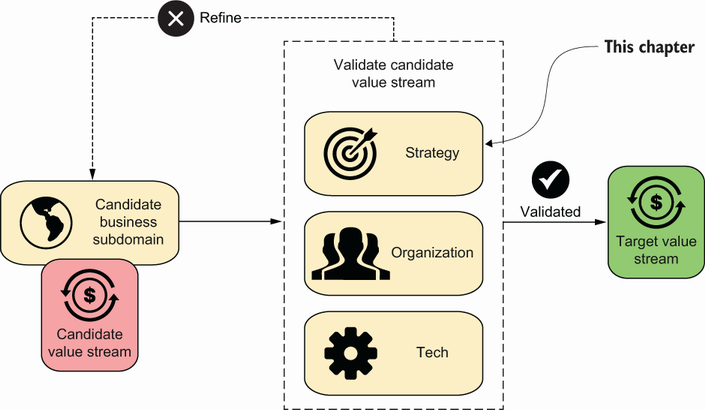
Use the portfolio view to verify that each candidate value stream fits the wider strategic picture. section 10.0

