A business may recognize the same customer in its loyalty records and a partner’s campaign data, yet need to compare those records without sharing email addresses. A hash function transforms raw data into an unreadable, fixed-length string. The resulting value can serve as a matching key in a data clean room. section 8.1.1 section 8.2
Hashing is one step in a controlled matching workflow:
- Each partner hashes or otherwise masks sensitive fields, such as email addresses or loyalty IDs, before upload. section 8.2
- The clean room matches protected identifiers and aggregates the records. section 8.1
- Partners receive aggregated audience or performance insights rather than exposed raw records. section 8.1
A platform-managed choice
With Google Ads Data Hub, a data partner can hash its data using SHA-256 before uploading the values to its Google Ads account, or have Google perform the hashing on its servers. The choice affects where raw data is handled; it does not remove the need to trust the platform’s controls. section 8.1.1 section 8.1.1
Hashing protects identifiers during exchange and matching, but it is not a complete privacy strategy. Clean rooms also rely on controlled access and aggregated outputs; some jurisdictions may require a data protection impact assessment before personal data is shared. section 8.1 section 8.1.1
Figure 8.4 A high-level secure matching process in a data clean room
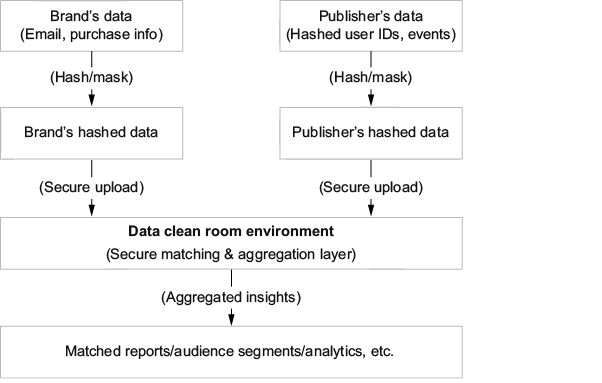
Follow the path from masking sensitive fields through secure matching to aggregated insights. section 8.2















