A hashtag is a relevant keyword or phrase prefixed with # in a tweet. It categorizes content and helps people discover posts about a topic, increasing visibility among interested users. section 2.4
Model each hashtag as its own Tag node rather than as text buried in a Tweet. Connect a tweet to every tag it contains with a specific HAS_TAG relationship; a tweet can therefore link to many tags. section 2.4.2
Specific relationship types make the graph easier to query and maintain:
- Use HAS_TAG from Tweet to Tag, so following that relationship always reaches a Tag node. section 2.4.2
- Avoid a generic HAS relationship for authors, tags, and links, because queries must inspect more relationships and target node types. section 2.4.2
- Treat tweets and tags as a bipartite network: connections run between the two node types, not directly between two tweets or two tags. section 7.0
Build a hashtag co-occurrence network
Two tags co-occur when the same tweet uses both. Create direct CO_OCCURRENCE relationships between those Tag nodes with Cypher: MATCH (s:Tag)<-[:HAS_TAG]-(:Tweet)-[:HAS_TAG]->(t:Tag) CREATE (s)-[:CO_OCCURRENCE]->(t); This projection supports analysis of tag communities and importance for a hashtag strategy. section 7.0
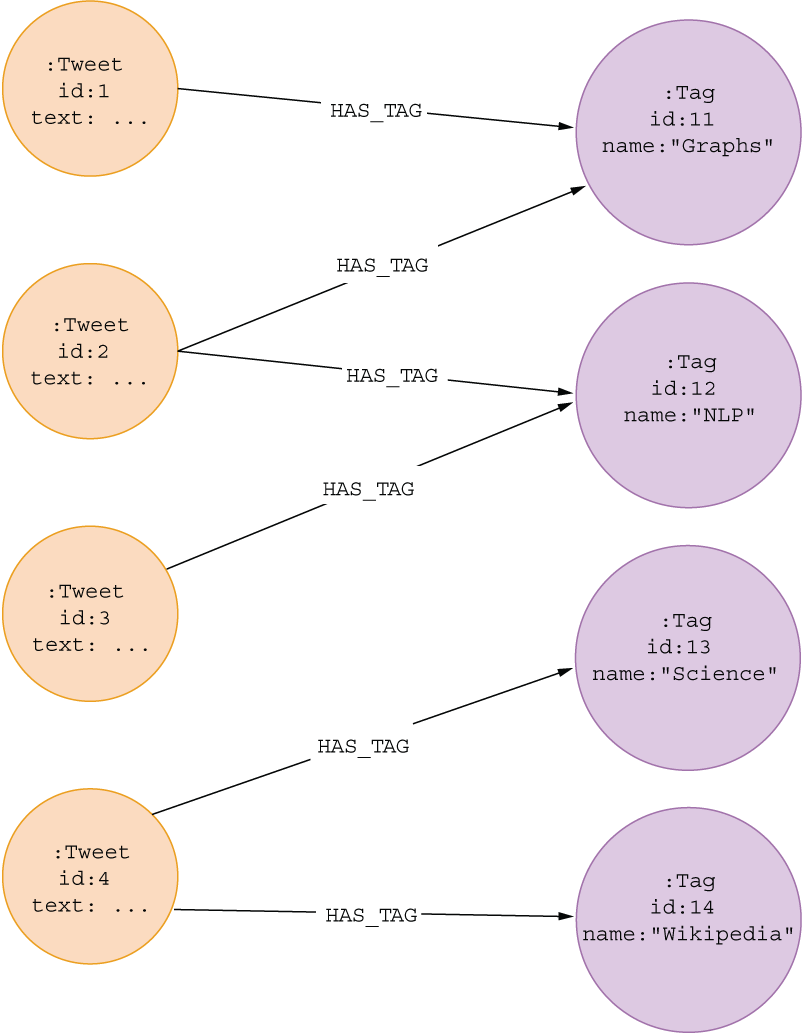
This graph view shows why hashtags are separate Tag nodes connected to tweets rather than generic properties or relationships. section 2.4.2

