Haskell is a compiled, garbage-collected pure functional language for building safe, composable software. Its declarative style describes values and transformations rather than a sequence of state-changing instructions. Pure functions consume inputs and produce outputs without side effects, helping make behavior and tests easier to reason about. section 1.5 section 1.2.1 section 1.2.3
Its central design tool is abstraction: algebraic data types, type classes, monads, lazy evaluation, software transactional memory, and generalized algebraic data types support reusable components and maintainable designs. Effects such as file access, networking, time, randomness, and mutable state require explicit control; monadic programming is the named approach for handling them. section 1.1.1 section 1.2.2 section 1.2.3
Haskell is especially suited to problems with clear definitions, composition, and well-defined input and output:
- Build cryptographic and distributed systems, security-related protocols, and web-server logic while minimizing state and unexpected behavior. section 1.3.1
- Create compilers, interpreters, domain-specific languages, file converters, and data-processing tools whose logic is largely definitional. section 1.3.1
- Compose large systems with varied data sources, including backend data-analysis and complex data-management software. section 1.3.1 section 1.5
High abstraction trades direct machine control for safety and convenience. The runtime manages threads, allocation, and garbage collection, so real-time-critical software, state-heavy multimedia or games, device drivers, and operating systems demand careful technical study and are poor default targets. section 1.3.2 section 1.1.2
Learning through complete programs
Start with syntax, basic types, functions, strings, lists, guards, pattern matching, and immutable transformations in a basic project. Representative projects include a word-ladder AI, a CSV formatter and search tool, audio and image processing, a musical synthesizer, a multithreaded image-processing library, and a web server. A music program models western music theory as types and values, then layers composition-friendly abstractions over sound generation. section 2.0 section 1.4 section 10.0
Figure 1.1 The Freedom-Safety relationship
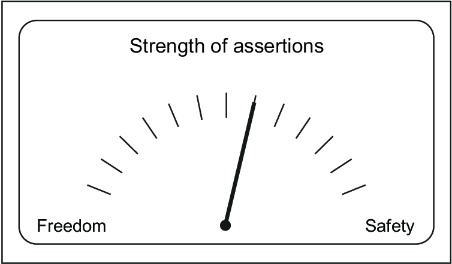
Compare the trade-off between programmer freedom and language-enforced safety when choosing Haskell for a problem. section 1.1.2
