A priority queue must return the highest-priority item currently stored. A heap makes that possible by requiring every node to have at least as high a priority as its children. The root therefore has the highest priority in the whole heap. In a min-heap, smaller priority values rank higher; in a max-heap, larger values rank higher. section 2.5.3 section 2.5.5
Keep the ordering rule separate from the heap’s structural rules. A binary heap has at most two children per node and forms a complete, left-adjusted tree. These structural invariants let an array store its nodes from top to bottom, left to right, without parent or child pointers. With zero-based indices, node i has children at 2i+1 and 2i+2; a non-root node’s parent is at floor((i−1)/2). section 2.5.3
Figure 2.4 A binary heap. Only priorities are shown for the nodes (elements are irrelevant here).The numbers inside the small squares show the indices of the heap elements in the array. Nodes are matched into array elements top to bottom, left to right. Top: the tree representation for the heap. Notice how every parent is smaller than (or at most equal to) its children and, in turn, all elements in its subtree. Bottom: the same heap in its array representation.
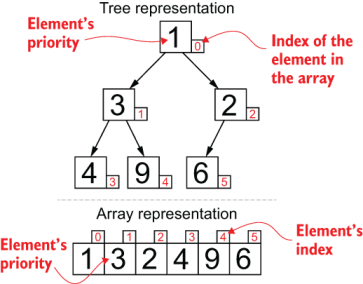
Compare each parent with its children, then follow the same nodes into their array positions. section 2.5.3
Operations preserve the structure but may temporarily break priority ordering:
- Insert: append the new item, then bubble it up while it outranks its parent. In a D-way heap, this takes at most logD(n) swaps. section 2.6.3
- Remove or change a priority: push an item down if a child outranks it; an increased priority may instead require bubbling up. section 2.6 section 2.6.3
- Heapify an array: visit internal nodes from right to left, pushing each down after its children’s sub-heaps are valid. section 2.6.7
The same ordering rule works for a D-way heap: each node has at most D children, while the tree remains complete and left-adjusted. In a zero-based array, node i’s children occupy positions Di+1 through D(i+1), and a non-root node’s parent is at floor((i−1)/D). Changing the branching factor changes how many children a repair step must consider. section 2.5.5 section 2.6.7
When a repair order matters
Suppose an update raises the priorities of both a parent and its child to the same value. If the child is bubbled up first, it stops at its equal-priority parent. Bubbling the parent up afterward can leave the child beneath a lower-priority node. Updating duplicate occurrences requires an order that restores the invariant for all of them, such as left-to-right bubble-up calls. section 2.6.6
A treap also enforces a heap invariant on priorities, alongside binary-search-tree ordering on keys. When insertion places a key correctly but its priority outranks its parent, rotations move it upward: swapping nodes as in an array heap would not serve the tree’s key ordering. Deletion can likewise rotate a node downward until it becomes a removable leaf. section 3.3.4 section 3.3.5
