The TLS heartbeat extension checks connection liveness by letting a client request an arbitrary payload back from the server. A normal request might ask for the 12-byte payload “good_morning”; the client verifies that the response matches. section 10.6
The security failure appears when the requested payload length is trusted without checking the bytes actually supplied. A malicious client can request thousands of bytes while sending only a few, causing the server to read beyond the heartbeat buffer and disclose adjacent memory. section 10.6
Figure 10.9 The Heartbleed vulnerability: a malicious client requests a very long heartbeat but provides very little data to echo. The vulnerable server reads beyond the heartbeat buffer into other areas of memory.
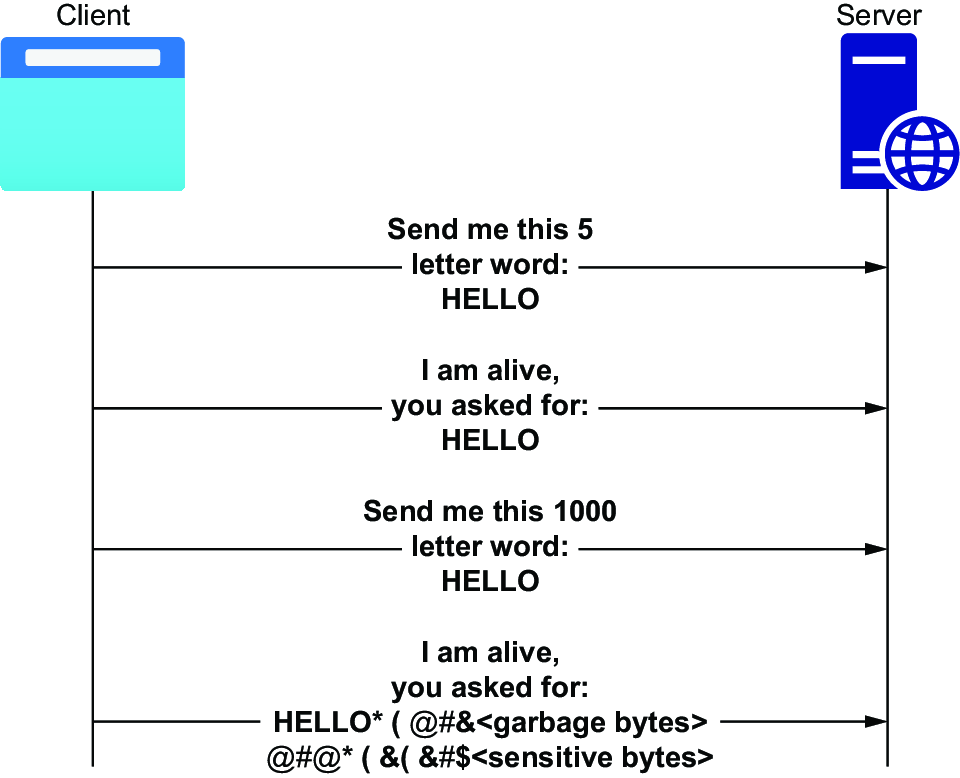
Trace how a long heartbeat request with little payload makes a vulnerable server return unintended memory. section 10.6
Listing 10.7 (OpenSSL 1.0.1f)—ssl/d1_both.c
#ifndef OPENSSL_NO_HEARTBEATS
int
dtls1_process_heartbeat(SSL *s)
  {
  unsigned char *p = &s->s3->rrec.data[0], *pl;  #1
  unsigned short hbtype;
  unsigned int payload;
  unsigned int padding = 16; /* Use minimum padding */

  hbtype = *p++;
  n2s(p, payload);  #2
  pl = p;  #3

  if (s->msg_callback)
    s->msg_callback(0, s->version, TLS1_RT_HEARTBEAT,
      &s->s3->rrec.data[0], s->s3->rrec.length,
      s, s->msg_callback_arg);

  if (hbtype == TLS1_HB_REQUEST)
    {
    unsigned char *buffer, *bp;
    int r;

    buffer = OPENSSL_malloc(1 + 2 + payload + padding);  #4
    bp = buffer;

    *bp++ = TLS1_HB_RESPONSE;
    s2n(payload, bp);
    memcpy(bp, pl, payload);   #5
    bp += payload;
    RAND_pseudo_bytes(bp, padding);

    r = dtls1_write_bytes(s, TLS1_RT_HEARTBEAT, buffer, 3 + payload + padding);
Inspect the vulnerable OpenSSL 1.0.1f path, especially attacker-controlled length parsing and the unchecked memcpy operation. section 10.6
Defensive implementation rules:
- Treat client-supplied lengths as untrusted, validate buffer bounds before copying, and prefer functions that require explicit length limits. section 10.6
- Recognize that memcpy is not inherently unsafe, but blindly copying attacker-controlled lengths can produce buffer overreads or overwrites. section 10.6
