helm install deploys a Helm chart into a Kubernetes cluster. Helm downloads manifests describing the required components and applies them to create Kubernetes-managed resources. section 5.1.1
Use the command as part of an infrastructure-to-application workflow:
- Define the Kubernetes constructs and chart parameters required by the component. section 5.1.1
- Install the chart into the target namespace and Kubernetes cluster. section 5.1.1
- Configure application services with the provisioned instance URL and credentials, including database connection details. section 5.1.1
- Maintain the resulting infrastructure with backups and tested fail-over mechanisms. section 5.1.1
Provisioning PostgreSQL
Installing a PostgreSQL Helm chart creates resources such as StatefulSets and Deployments. The Conference application can then connect through the new instance URL and credentials, either directly or through a Kubernetes Secret. section 5.1.1
Figure 5.2 Provisioning a new PostgreSQL instance using the PostgreSQL Helm Chart. #1 Install a helm chart into a Namespace inside a Kubernetes Cluster; #2 The chart creates Kubernetes resources such as StatefulSets and Deployments to provision a PostgreSQL instance; #3 A Service needs to connect to the newly created instance, this can be done manually or by referencing a Kubernetes Secret that contains the credentials and details on how to connect.
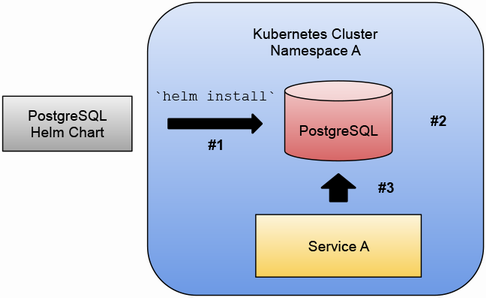
Follow the provisioning sequence from chart installation through resource creation and service connection. section 5.1.1
