A Hessian matrix captures how the slope of a scalar-valued function changes in every pair of input directions. Where a gradient gives one first derivative per variable, the Hessian differentiates every gradient entry again. For a function of x, y, and z, this produces a square matrix of second-order partial derivatives; its diagonal entries describe repeated differentiation with respect to one variable, while off-diagonal entries describe cross-variable change. The matrix is symmetric when reversing differentiation order gives the same result. section 6.1
Its practical value is curvature information. Gradient descent uses a local linear approximation and moves according to the gradient alone. Newton’s method combines the gradient with the inverse Hessian, forming a local quadratic approximation that can provide a more informative descent direction. In the multivariate update, the inverse Hessian plays the role that division by the second derivative plays for a one-variable function. section 6.1 section 6.1.1
To use a Hessian in Newton-style minimization:
- Evaluate the gradient vector and Hessian matrix at the current estimate. section 6.1.1
- Multiply the gradient by the inverse Hessian and negate the result to obtain the descent direction. section 6.1.1
- Use a step length of 1 for Newton’s method, update the estimate, and stop when successive estimates are sufficiently close. section 6.1.1
Following the Branin surface
For the two-variable Branin function, the Hessian is computed by analytically differentiating the gradient vector. Starting at [2, -5], Newton’s descent uses that Hessian and the gradient at each iteration to move toward a local minimum. Compared with gradient descent from the same start, its path is more direct because each update uses a second-order local approximation. A zero gradient can also occur at a saddle point, so descent methods can converge there as well. section 6.1.1
Hessians also guide sequential ensemble learning. A custom LightGBM objective can return both a loss gradient and Hessian; the Hessian is used while learning tree leaf nodes. With focal loss, first and second derivatives may be approximated numerically, provided the loss, metric, and objective accept array-like labels and predictions. In Newton boosting, Hessian-weighted gradients serve as residuals and use curvature to increase emphasis on higher-loss examples. section 5.4.3 section 7.3
Figure 6.3 We compare the solution paths of Newton’s descent and gradient descent starting from [2,-5] (square) and both converging to one of the local minima (circle). Newton’s descent (solid line) progresses toward the local minimum in a more direct way compared to gradient descent (dotted line). This is because Newton’s descent uses a more informative second-order local approximation with each update, while gradient descent only uses a first-order local approximation.
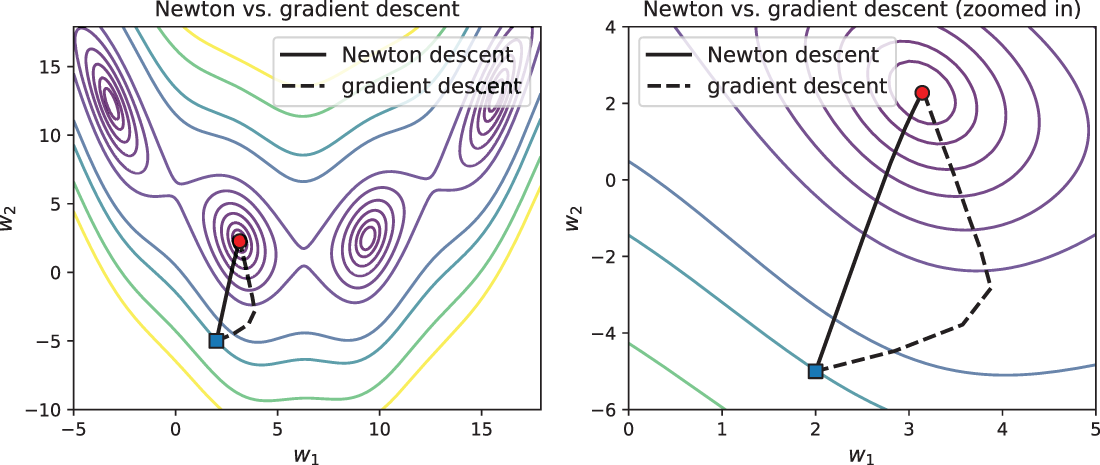
Compare Newton and gradient-descent paths from the same starting point to see how second-order curvature information changes the update direction. section 6.1.1

