A hierarchical community structure organizes graph communities at multiple granularities, supporting analysis of broad groups alongside finer subcommunities. Community detection assigns entities to groups, while generated summaries make those groups usable for retrieval. section 7.2.4
The smaller GraphRAG implementation uses one community level and therefore skips hierarchical processing. The hierarchy remains a design choice for larger graphs and broad information-discovery tasks. section 7.3.1 section 7.2.4
Selecting a community level creates a practical detail–efficiency trade-off:
- Lower-level communities provide more detailed reports but require more LLM calls and processing time. section 7.3.1
- Higher-level communities improve efficiency through more abstract summaries but can lose useful granularity. section 7.3.1
- Community counts and sizes depend on graph structure, and Louvain results can vary between runs. section 7.2.4
Using communities for global search
A global retriever selects community summaries at a chosen hierarchy level, maps each summary to rated key points, filters and aggregates the strongest points, and gives them to an LLM for final synthesis. section 7.3.1
Figure 7.4 Global search
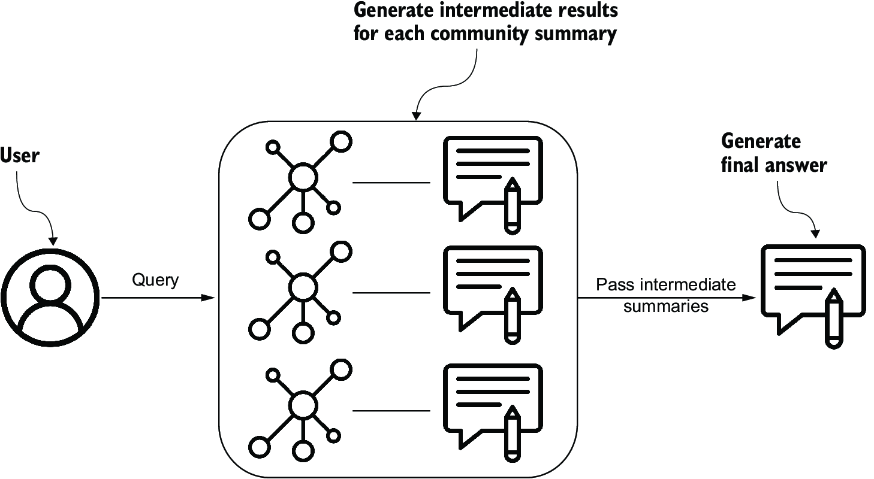
Use the global-search diagram to trace how community-level summaries become intermediate evidence and then a synthesized answer. section 7.3.1
