liveBook · Manning

High-risk system

As explained in Introduction to Generative AI, Second Edition

A high-risk AI system is an AI system whose use can significantly affect safety or fundamental rights and therefore receives heightened regulatory oversight.

A high-risk AI system is an AI application that can significantly affect safety or fundamental rights. Under the European Union’s risk-based AI Act, it receives stricter oversight than limited-risk systems but is not automatically banned. section 10.30

High-risk systems must meet requirements intended to reduce harm, including:

  • assessment before market access and monitoring throughout the system’s lifecycle section 10.30
  • data governance, accuracy, nondiscrimination, risk management, record-keeping, technical documentation, and human oversight section 10.30
  • registration in an EU-wide database and possible large fines for noncompliance section 10.30
Figure 10.7 The four risk categories in the AI Act
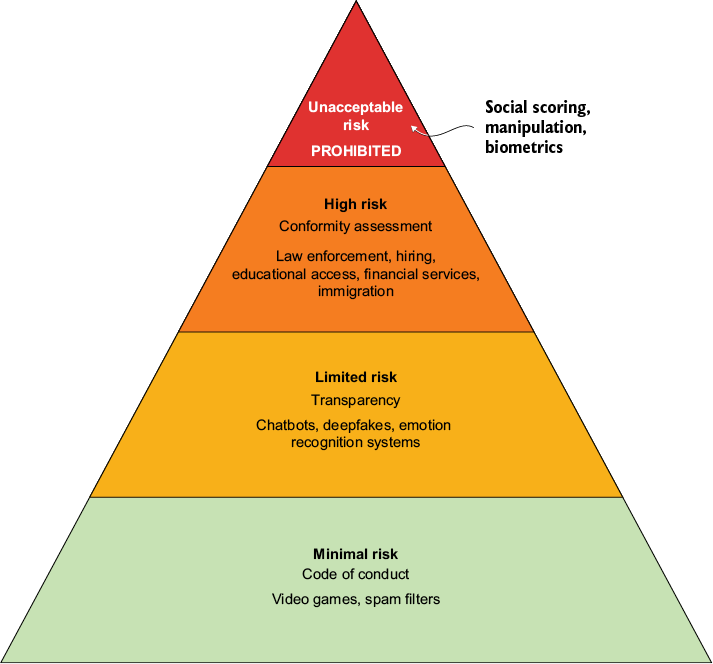
A pyramid of risk levels

AI-generated content may be incorrect.

Use the four-category overview to compare high-risk systems with unacceptable-, limited-, and minimal-risk applications. section 10.30

How Introduction to Generative AI, Second Edition covers it

How deep it goes
Defines the category and lists lifecycle controls, but does not detail their technical implementation.
Examples
Includes law enforcement, hiring, educational access, financial services access, and regulated consumer products.
What you can do after
Evaluate whether an AI application requires stricter controls and identify the principal compliance safeguards involved.
How it connects
Connects risk-based regulation with fundamental rights, human oversight, data governance, nondiscrimination, and risk management.

Related concepts

This explainer was generated by Manning's knowledge graph from the text of Introduction to Generative AI, Second Edition. The section links point to the parts of the book it draws on.