HIPAA, the Health Insurance Portability and Accountability Act of 1996, established a federal trust baseline as health records moved from paper into networked digital systems. It responded to inconsistent state-level protections and the heightened risk that more accessible health data could also be breached. section 1.2.2
HIPAA is a statute, not a complete implementation checklist. Developer-facing obligations emerge as Congress’s statute is interpreted through administrative rules and codified into regulations. Its five titles address insurance portability, fraud and abuse, administrative simplification, tax provisions, group health insurance enforcement, and employer tax deductions; Title II is the central title for developers handling health data. section 1.2.4
Figure 1.3 How a law becomes developer-facing requirements: Statute → Administrative Rule → Codified Regulation.
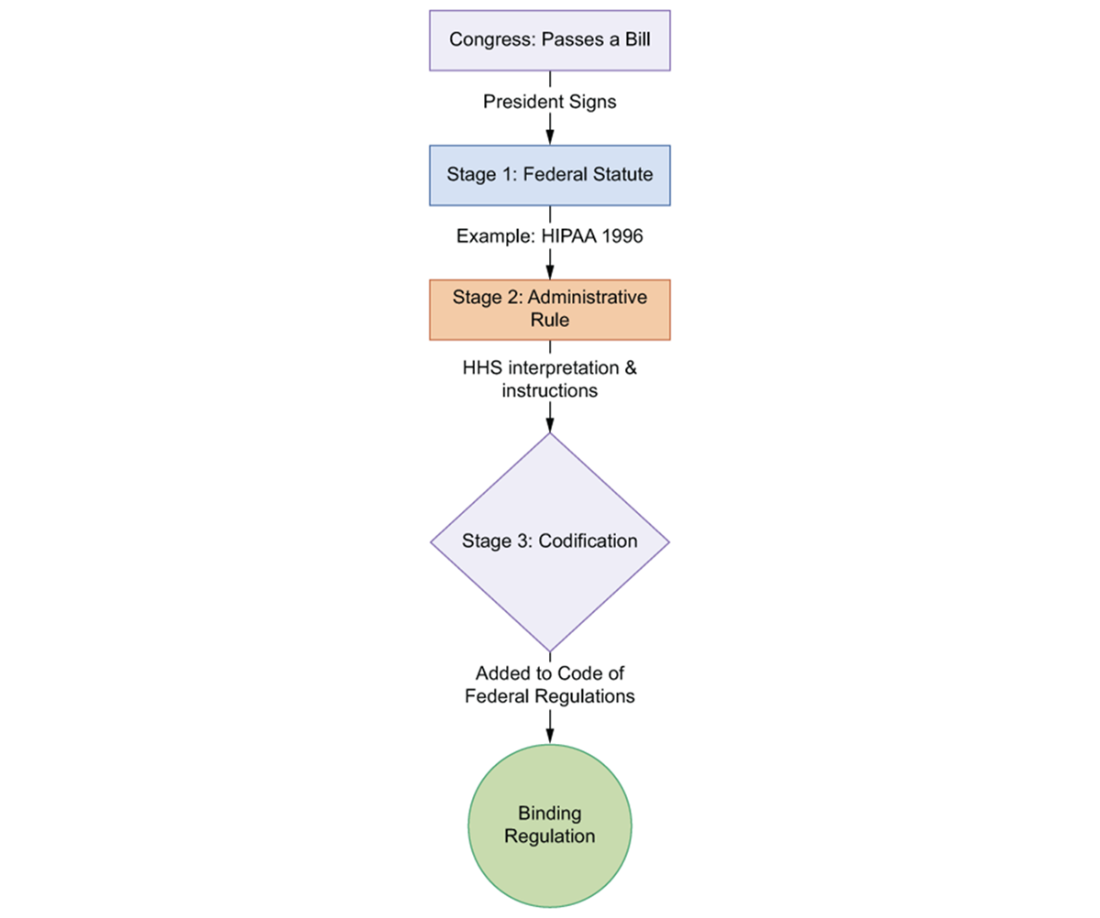
Trace how a federal statute becomes technical constraints: statute, administrative rule, then codified regulation. section 1.2.4
Administrative Simplification directs HHS to establish national standards for:
- Electronic transactions, code sets, and unique identifiers. section 1.2.4
- Health plans, healthcare clearinghouses, and providers transmitting health data electronically in HHS-specified standard transactions. section 1.2.4
“HIPAA compliance” commonly refers to rules adopted after 1996. The Privacy Rule sets limits and conditions for PHI use and disclosure across paper, electronic, and oral forms, establishes patient rights to access, disclosure accounting, and amendment, and applies a minimum-necessary standard with defined exceptions. The Security Rule complements it by setting confidentiality, integrity, and availability standards specifically for electronic PHI (ePHI). section 1.2.5 section 1.2.5
Design question for a health product
When a product creates, receives, or transmits PHI for or on behalf of a HIPAA covered entity, treat each technical decision as a privacy and security risk. Determine whether the data is PHI or ePHI, whether a proposed use or disclosure is permitted, and how electronic data will preserve confidentiality, integrity, and availability. section 1.2.5
HIPAA remains part of an evolving health IT policy arc. HITECH accelerated EHR digitization, while the 21st Century Cures Act advanced interoperable, API-driven access. Together, these policies connect privacy and security expectations with a shift from fragmented documents, files, and faxes toward standardized real-time data exchange. section 1.2.6 section 1.5