Gradient boosting can be effective but slow on large data sets because every regression tree must examine many possible split points. Histogram-based gradient boosting accelerates this step by replacing individual feature values with a smaller set of bins. section 5.2.3 section 5.2.4
The split-finding process works as follows:
- Collect feature values and assign them to a fixed number of ordered buckets. section 5.2.4
- Evaluate candidate tree splits only between successive buckets instead of between every pair of successive data points. section 5.2.4
- Use the best bucket boundary according to the tree’s split criterion, then continue gradient boosting with the resulting tree. section 5.2.4 section 5.0
Fifty points versus five bins
For 50 ordered data points, standard tree learning evaluates 49 possible splits. Binning those values into five buckets leaves only four bucket boundaries to evaluate, substantially reducing split-search work. On the breast cancer data set, HistGradientBoostingClassifier achieved a 4.2% test error, compared with 4.9% for GradientBoostingClassifier in the corresponding example. section 5.2.4 section 5.2.3
Figure 5.17 Left: A simple 1D regression problem with 50 data points. Center: Standard tree learning evaluates every possible split, which is illustrated by a line between each pair of data points. The best split is the one with the lowest split criterion (here, squared loss). Right: Histogram-based binning first puts the data into five buckets, and then evaluates the splits between each pair of data buckets. Again, the best split is the one with the lowest split criterion (also squared loss).
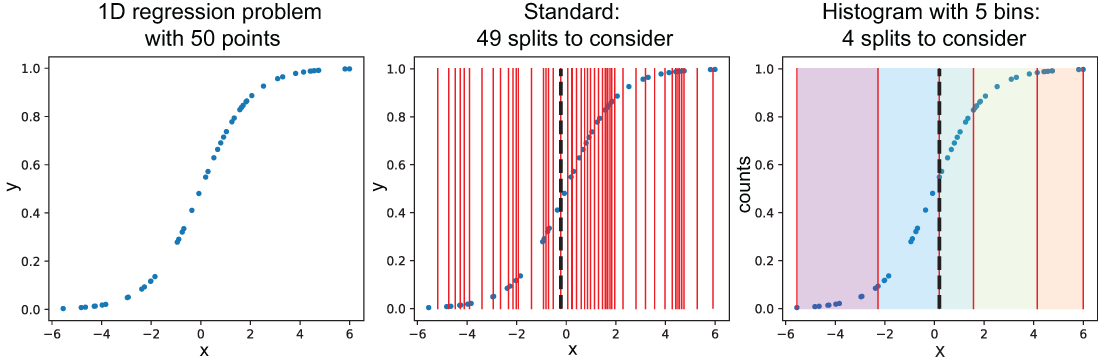
Use the figure to compare every-point split search with five-bucket histogram splitting and their squared-loss criteria. section 5.2.4
