Holt-Winters exponential smoothing forecasts demand by updating estimates so newer observations carry more weight while older observations matter less. It is especially useful when planners need to interpret and project level, trend, and seasonality. section 14.1.1
Use the method with attention to pattern complexity and available history:
- Model recurring promotions or holidays through seasonal factors distributed across cycles such as days, weeks, or years. section 14.1.1
- Inspect level, trend, and seasonality because the decomposition helps planners understand how historical demand becomes a future projection. section 14.1.1
- Avoid unnecessary complexity: models that impose trend on seasonal products can overfit, while a moving average may perform better with little data. section 14.1.1
Seasonal demand allocation
A recurring demand pattern might show 30% more sales in Q2, 20% less in Q3, and 10% less in Q4 than usual. Across the complete cycle, the seasonal impact balances to zero. section 14.1.1
Figure 14.3 Historical sales and seasonality of Toyota in Norway
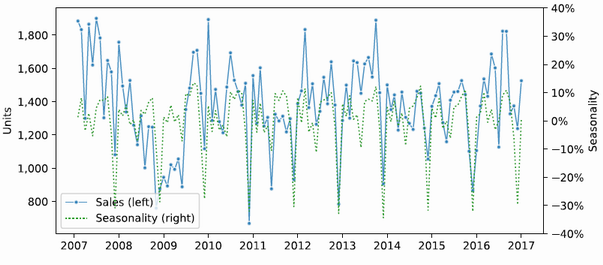
Inspect the Toyota Norway figure to connect historical sales with the seasonal component used for interpretation and projection. section 14.1.1

