A homeomorphism transforms one manifold into another by stretching or squishing without cutting, breaking, or folding. It preserves path-connectedness and can make geometric structures easier to analyze or classify. section 12.2 section 12.4
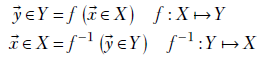
Formally, functions f and f⁻¹ connect sets X and Y: both are one-to-one and continuous, so nearby points remain nearby in both directions. A circle arc can therefore become a line segment, and a spherical patch can become a plane patch. section 12.2
Making classes easier to separate
Neural-network layers can successively transform an input manifold until classes that originally surround one another become separable by a line or plane. A linear transformation, translation, and sigmoid are continuous; when the weight matrix is square and has nonzero determinant, the transformation is invertible and therefore homeomorphic. A zero determinant instead causes dimensionality reduction. section 12.3
Use the geometric figure to compare stretching a circle arc into a line and mapping a spherical patch onto a plane. section 12.2
