A hostname identifies a specific device on a network. It may be a simple name such as srv1 or a fully qualified domain name (FQDN) such as srv1.example.com. A partially qualified domain name (PQDN), such as www, identifies a host only within its domain. section 3.1.3
Figure 3.3 The DNS hierarchy. All domains are under the root domain, represented by “.”. Under the root domain, there are various top-level domains. Under each top-level domain, there are various second-level domains. The “google” domain, a subtree under the “com” top-level domain, is highlighted.
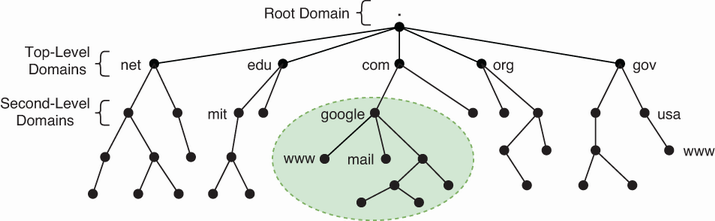
Use the DNS hierarchy to relate hostnames, domains, subdomains, top-level domains, and the root. section 3.1.3
On Cisco IOS, hostname-based communication can be configured and verified with:
- ip domain name jeremysitlab.com defines the default domain appended to queries containing only a hostname. section 3.2.2
- ip host pc2.jeremysitlab.com 10.0.0.12 creates a manual hostname-to-IP mapping. section 3.2.2

