liveBook · Manning

HSRP priority

As explained in Acing the CCNA Exam: Volume 1 Fundamentals and Protocols

HSRP priority is a numeric value used to rank routers when electing the active router.

HSRP priority is a numeric value that influences which router becomes the active router in an HSRP group. The router with the highest priority wins; if priorities match, the router with the highest IP address wins. section 19.3

Making R1 active

With default priority 100, R2 at 10.0.0.3 would beat R1 at 10.0.0.2. Configure R1 with `standby 1 priority 105` to make it active. Add `standby 1 preempt` so R1 retakes the active role after recovering from a failure. section 19.3

Figure 19.7 An HSRPv2 group of two routers. R1 is the active router, and R2 is the standby. If R1 fails, R2 will become the active router. However, because preemption is enabled on R1, it will retake its role after it recovers from the failure.
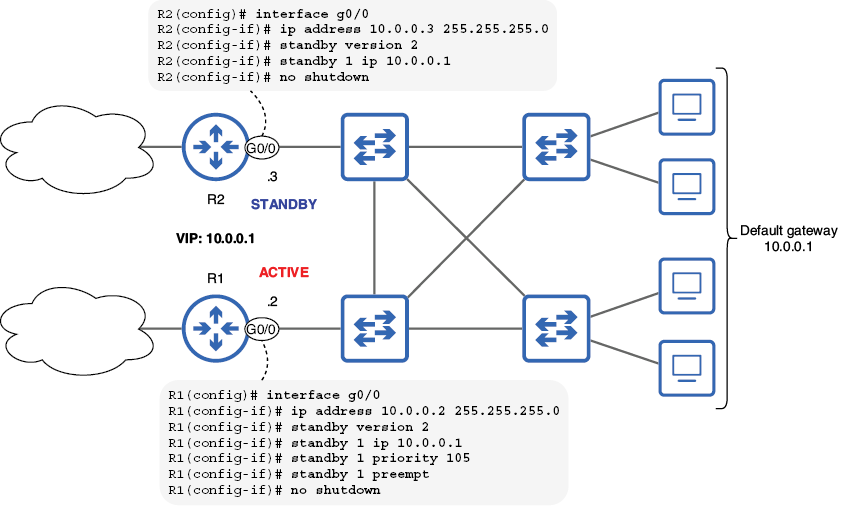
Use the diagram to follow the active and standby roles during R1 failure and recovery. section 19.3

How Acing the CCNA Exam: Volume 1 Fundamentals and Protocols covers it

How deep it goes
Explains priority comparison, IP-address tie-breaking, configuration, and preemption, but does not develop broader HSRP internals.
Examples
Uses two routers, priorities 105 and 100, addresses 10.0.0.2 and 10.0.0.3, CLI listings, and an HSRP role diagram.
What it assumes
Assumes interface addressing and teaches HSRP version, group, virtual IP, priority, and preemption commands in sequence.
What you can do after
Configure HSRP priority and preemption to select and restore a preferred active router.
How it connects
Connects HSRP priority to active router, standby router, virtual IP, HSRPv2, and preemption.

This explainer was generated by Manning's knowledge graph from the text of Acing the CCNA Exam: Volume 1 Fundamentals and Protocols. The section links point to the parts of the book it draws on.