HSRP version 1 (HSRPv1) provides first-hop redundancy by allowing a standby router to take over automatically when the active router fails. It uses multicast address 224.0.0.2 and virtual MAC addresses in the form 0000.0c07.acXX, where XX is the group number. section 19.2.1 section 19.4
Key HSRPv1 details include:
- Supports 256 groups, numbered 0 through 255, because the group identifier occupies two hexadecimal digits. section 19.2.1
- Supports IPv4, while HSRPv2 adds IPv6 support and uses different multicast and virtual MAC addresses. section 19.4
- Supports per-subnet load balancing by making different routers active for different HSRP groups. section 19.4
Virtual MAC examples
Group 1 uses 0000.0c07.ac01; group 15 uses 0000.0c07.ac0f. section 19.2.1
Figure 19.5 HSRP load balancing. R1 is the active router in subnet 1 and the standby router in subnet 2. R2 is the standby router in subnet 1 and the active router in subnet 2.
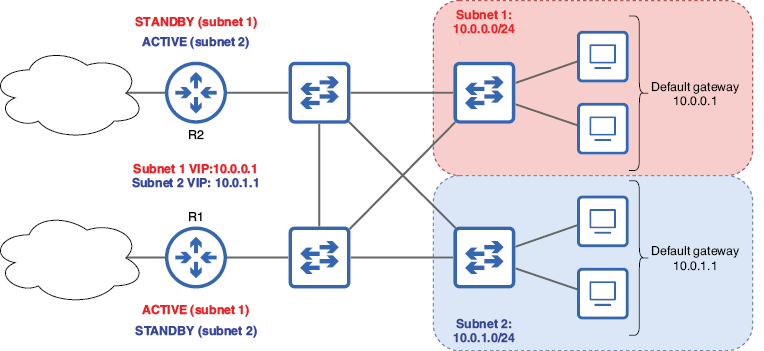
Illustrates how separate HSRP groups can distribute active-router responsibility across subnets. section 19.2.1
