liveBook · Manning

Nodule classification model

As explained in Deep Learning with PyTorch, Second Edition

A model that assigns candidate lung nodules to classes such as nodule or non-nodule, and later malignant or benign.

A nodule classification model assigns one label to each lung-candidate sample: nodule or non-nodule. It forms the classification stage of an end-to-end lung-cancer detection project and provides a foundation for later experiments. section 13.1

The model is trained through a complete data-and-evaluation pipeline:

  • Ct and LunaDataset classes provide data to DataLoader instances. section 13.1
  • Training and validation loops feed samples to the classifier and measure progress on a validation set. section 13.1
  • The initial target is nodule-versus-non-nodule classification; malignant-versus-benign classification comes later. section 13.1
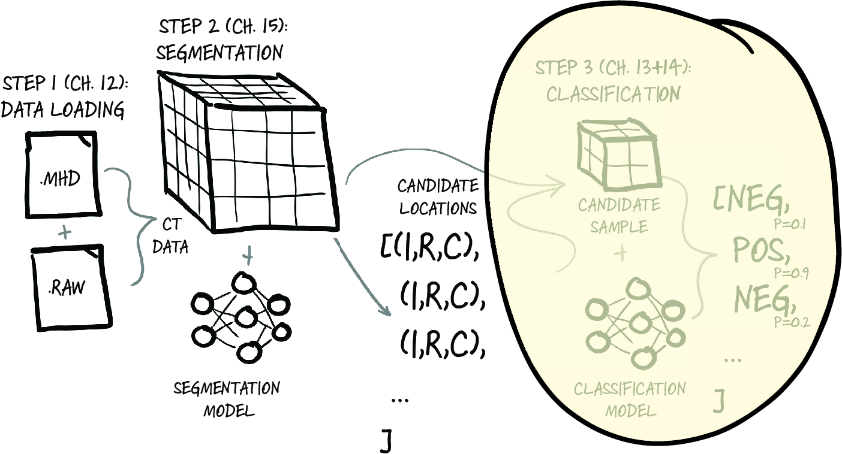
Figure 13.1 Our end-to-end project to detect lung cancer, with a focus on this chapter’s topic: step 3, classification
figure

The end-to-end project diagram locates classification as step 3 in the lung-cancer detection workflow. section 13.1

How Deep Learning with PyTorch, Second Edition covers it

How deep it goes
Descends to a foundational model, training loop, and validation loop, while deferring data limitations and malignant-benign classification.
Examples
Uses candidate samples labeled nodule or non-nodule, with malignant and benign as a later classification target.
What it assumes
Assumes Ct and LunaDataset classes plus DataLoader instances are available to supply training and validation data.
What you can do after
Build and train a baseline classifier, then evaluate progress with a validation loop.
How it connects
Connects classification with training loops, validation sets, datasets, and data loaders.

Related concepts

This explainer was generated by Manning's knowledge graph from the text of Deep Learning with PyTorch, Second Edition. The section links point to the parts of the book it draws on.