A deliberate gap is a capability a product intentionally does not provide, even though competing products offer it. The absence records a strategic constraint: it shows whom the product serves and what it refuses to become. section 5.5
Find deliberate gaps by asking:
- What capability is missing from the schema and implementation? section 5.5
- What trade-off does the absence create? section 5.5
- Which target customer does that constraint reveal? section 5.5
Cal.com's missing video platform
Cal.com has no VideoCall model or video-streaming implementation. Instead, integrations generate links through external providers. The gap keeps Cal.com focused on scheduling rather than competing with Zoom, while making the product dependent on provider APIs. section 5.5
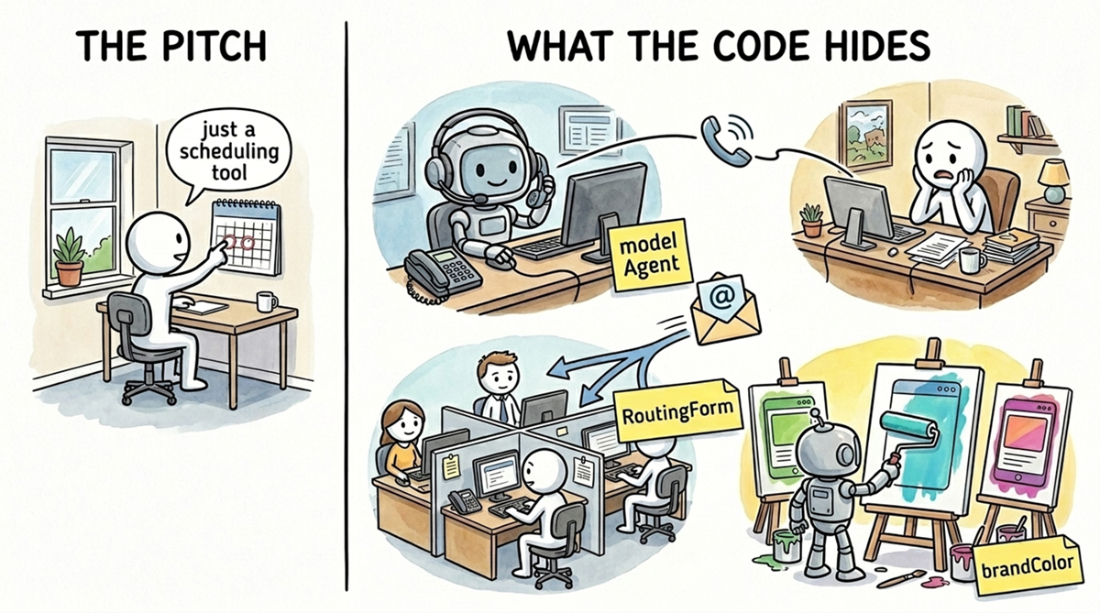
Figure 5.8 The marketing pitch is "just a scheduling tool," but the code reveals three features the company doesn't advertise: an AI agent that phones customers to confirm meetings (the Agent model), routing logic that sends each booking to the right team member (the RoutingForm), and white-label theming that re-skins the app for each customer (the brandColor field). The real strategy is in the code, not the marketing copy.
Map advertised features against hidden capabilities and absences to infer product strategy from implementation structure. section 5.5
