A hidden feature is a built product capability that public messaging does not advertise. Its presence can reveal a strategic bet about the product’s next move. section 5.5
Find it by reading the code for capabilities that marketing omits: inspect database models, API endpoints, configuration flags, and unwired interface elements. State each finding as a concrete fact, anchor it to a path or table, and explain the user or product implication first. section 5.5
A practical hidden-feature scan:
- Compare the public product description with the schema and API surface. section 5.5
- Look for models, endpoints, fields, or configuration that support an unadvertised capability. section 5.5
- Describe the capability as a noun-verb fact, then connect it to the product’s likely direction. section 5.5
Scheduling beyond the booking form
Cal.com contains an Agent model, a CalAiPhoneNumber model, and a phone-call endpoint. Together they indicate an AI agent that can call customers, confirm meetings, gather information, and reschedule—an expansion of scheduling into automated follow-up. section 5.5
Figure 5.8 The marketing pitch is "just a scheduling tool," but the code reveals three features the company doesn't advertise: an AI agent that phones customers to confirm meetings (the Agent model), routing logic that sends each booking to the right team member (the RoutingForm), and white-label theming that re-skins the app for each customer (the brandColor field). The real strategy is in the code, not the marketing copy.
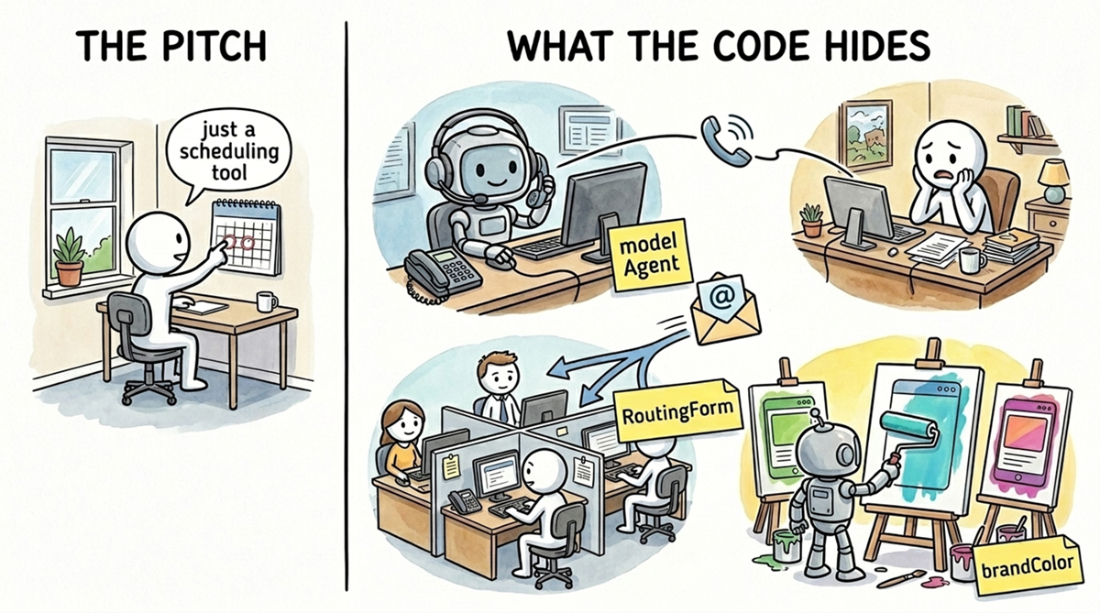
The figure makes the hidden-feature pattern immediately visible by contrasting a simple scheduling pitch with AI calling, routing, and white-label capabilities. section 5.5
