liveBook · Manning

Interface address

As explained in Crack Any Codebase with AI

An interface address is the identifier that selects an operation, such as a URL path, CLI subcommand, or qualified function name.

An interface address identifies the operation a user or program selects: a URL path such as /api/book/event, a CLI command such as git commit, or a qualified function name such as requests.get. It names the door; a method, flag, or signature supplies its key, and procedure code performs the operation. section 8.1

Three addresses, one pattern

POST /api/book/event selects a booking handler; git commit selects a commit operation; requests.get selects a library function. Their syntax differs, but each address identifies an entry point whose implementation reads, writes, checks, or calls external systems. section 8.1

Figure 8.2 An interface as a row of doors: each door is an address, each key is a method or signature, and the procedure inside is the business logic.
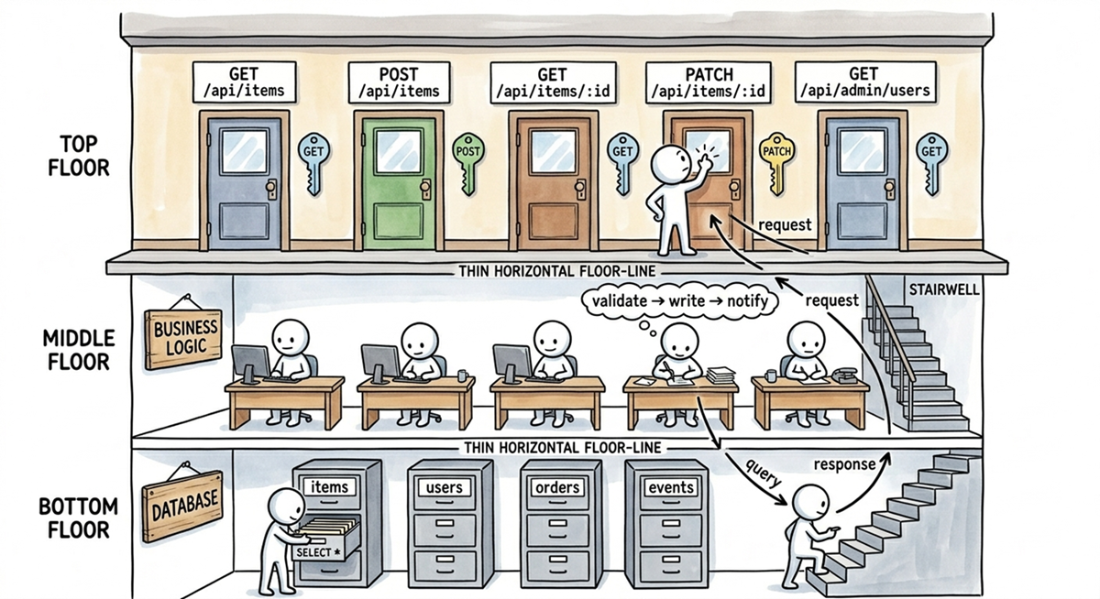
Use the row-of-doors model to separate an operation's address from its key and business procedure. section 8.1

How Crack Any Codebase with AI covers it

How deep it goes
Defines the address as one part of a door model and distinguishes it from keys, procedures, and schemas.
Examples
Uses /api/book/event, git commit, git log, requests.get, and a booking endpoint as concrete addresses.
What you can do after
Evaluate/understand interface entry points by separating their addresses, keys, procedures, and return behavior.
How it connects
Connects interface addresses to API endpoints, CLI commands, function signatures, business logic, and database schemas.

This explainer was generated by Manning's knowledge graph from the text of Crack Any Codebase with AI. The section links point to the parts of the book it draws on.