A learning note turns unfamiliar code into an editable map of the concepts, important files, and dependency relationships you need to understand. It counters rapid forgetting and comprehension debt through active retrieval rather than passive rereading. section 2.4
Build the note through a repeatable cycle:
- Skeleton: request a short structured outline of essential concepts and files. section 2.4.1
- Follow-up: ask precise questions that expose missing design choices. section 2.6
- Edit: rewrite the answers in your own words. section 2.4
- Quiz: test yourself, record missed questions, and repeat the gaps. section 2.4.4
A useful first draft
For nanoGPT, request two sections: up to eight plain-English concepts with exact code locations, and up to eight important files with their roles and dependency chain. The resulting map can connect prepare.py to train.bin and val.bin, then train.py, ckpt.pt, and sample.py. section 2.4.1
Figure 2.7 The learning note cycle: skeleton from AI, follow-up questions, rewrite in your own words, then self-quiz. Each round sharpens the note and deepens your understanding.
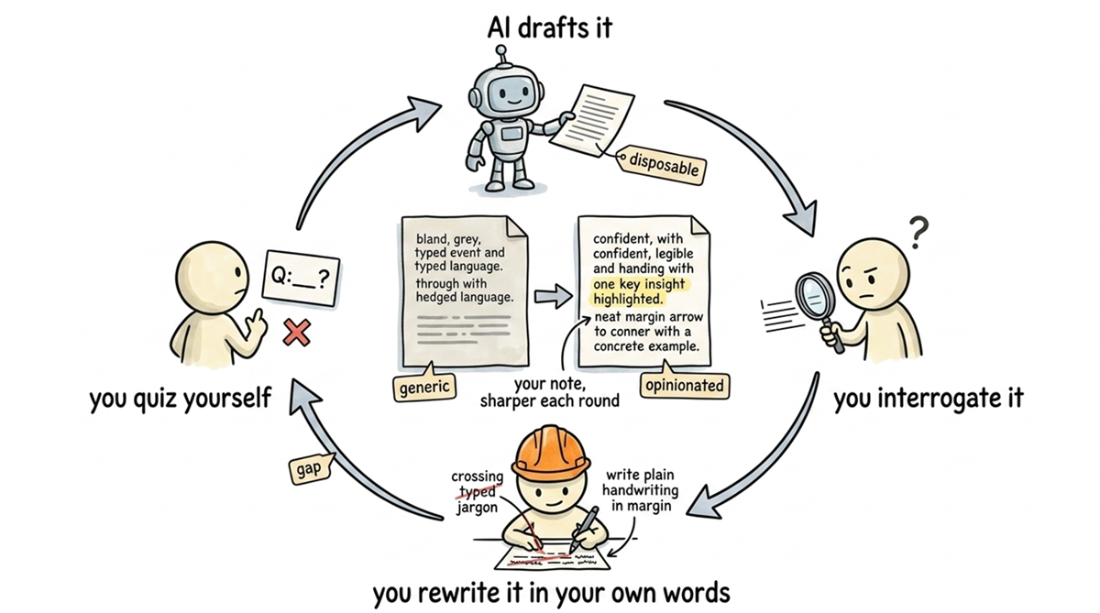
The cycle diagram shows how an AI-generated skeleton becomes understanding through questioning, rewriting, and self-quizzing. section 2.4
