The overview-then-zoom-in pattern maps a codebase broadly first, then investigates each core concept with a dedicated, focused question. Separating breadth from depth avoids summaries that are simultaneously shallow and scattered. section 3.3
Apply the pattern as a repeatable workflow:
- Ask one high-level query to identify the system’s core abstractions, components, services, tables, or endpoints. section 3.3.3
- Ask separate zoom-in questions that trace one feature, relationship, request, or execution path at a time. section 3.3.3
- Feed completed analyses into later prompts so independent responses become a coherent guide with cross-references. section 3.6
From schema map to table analysis
First ask, “What are all the tables and how do they relate?” Then ask, “What does the orders table store, what are its foreign keys, and how does it connect to users and products?” section 3.3.3
Figure 3.6 The overview-then-zoom-in pattern: one LLM call identifies the core abstractions from the full codebase, and a sequence of separate calls writes a chapter for each one. Every call receives the previously generated chapters as context, allowing the analysis to build on itself.
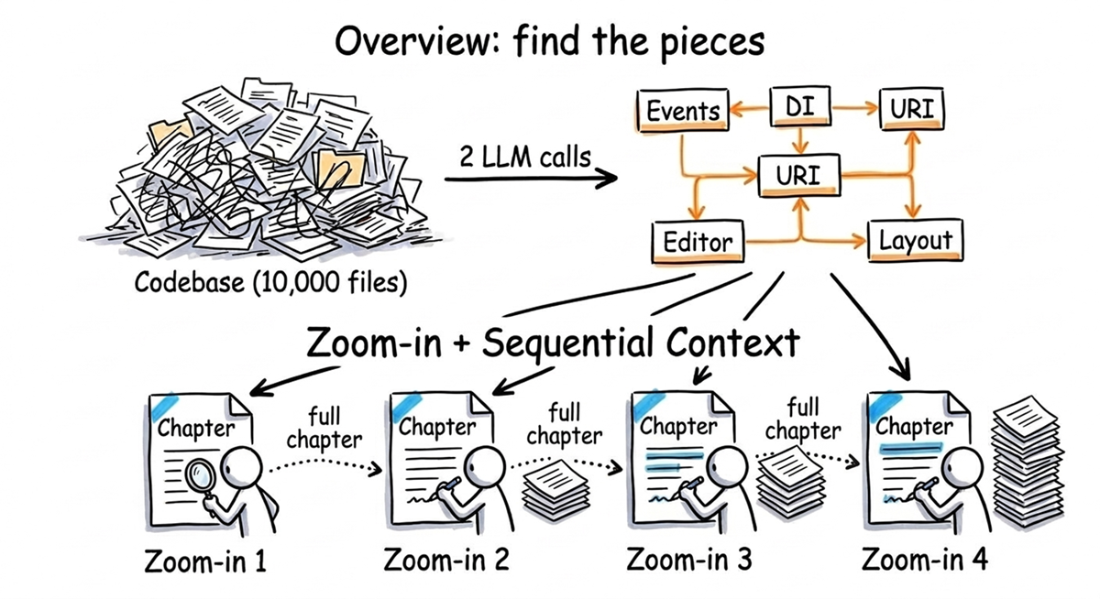
Shows the one-map-then-many-chapters structure and how prior analyses provide context for later deep dives. section 3.3
