An approval gate decides whether a proposed agent action may execute under current policy and risk. It routes the proposal to allow, deny, or human review. Unlike general human-in-the-loop interaction, the gate addresses authorization before execution; only the review route requires a person. section 9.2 section 9.9
Set authority per action, considering reversibility, scope, and potential consequences. Reversible reads may proceed automatically, while externally visible or irreversible operations may need review or a hard prohibition. Enforce these boundaries in the runtime, not just in the prompt. section 2.5 section 9.2
A practical routing sequence separates hard boundaries from routine work:
- Deny prohibited proposals first, so an allow rule cannot override a hard boundary. section 9.2.1
- Allow well-understood, low-risk proposals without consuming reviewer attention. section 9.2.1
- Ask a person about the remaining proposals, preserving the proposal for review and revalidating it before execution. Changed proposals return to routing. section 9.2.1
Figure 9.1 (continued) Part B: review and revalidate before execution. Changed proposals return to part A.
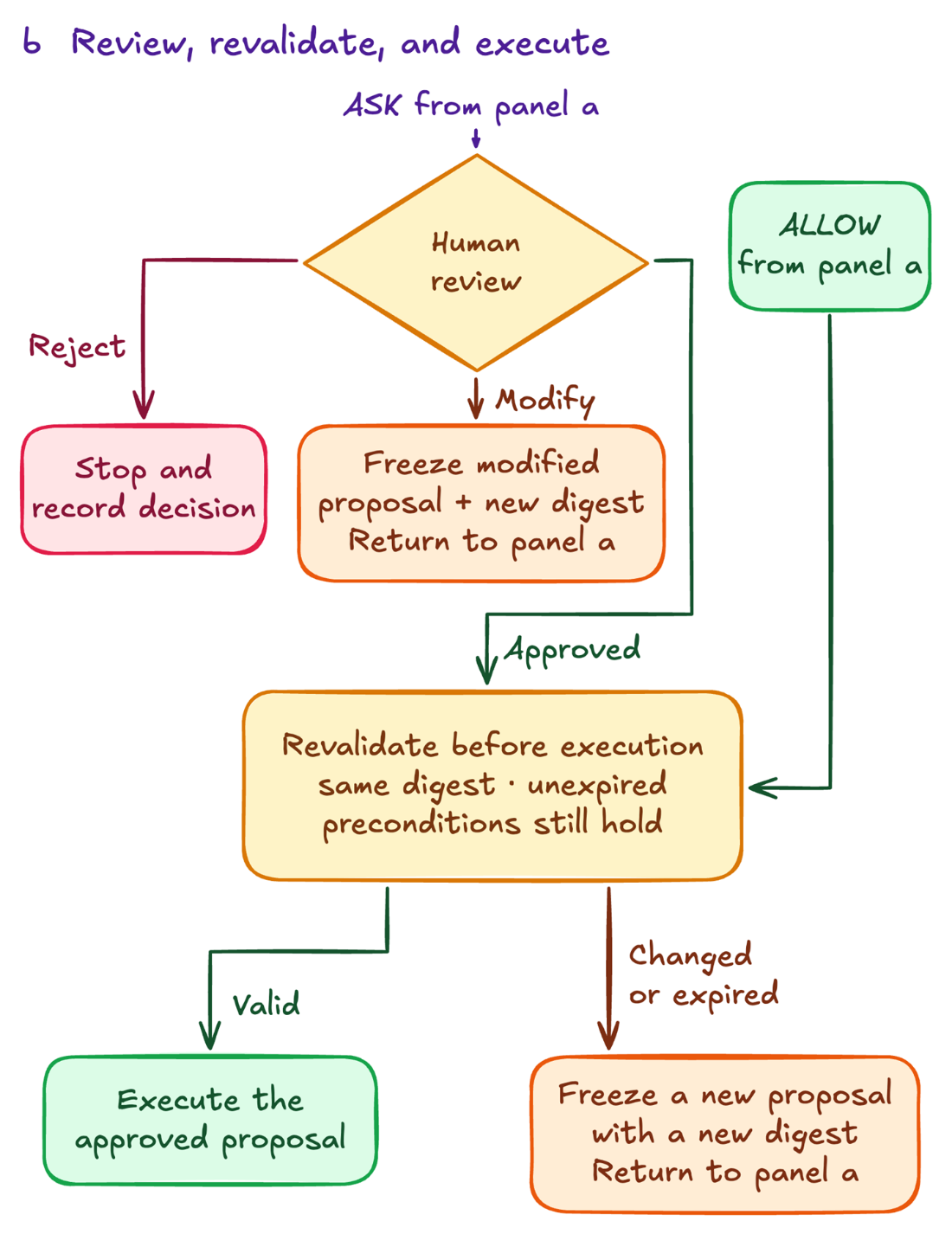
The review path returns changed proposals to routing before execution. section 9.2.1
Changed payment account
A vendor-payment agent proposes paying a familiar supplier an ordinary amount, but the bank account has changed. Valid credentials and an otherwise routine payment do not make the changed account routine; the gate routes the proposal for review instead of relying on those reassuring facts. section 9.2.1
Choose the default route, rule precedence, reviewer evidence, and timeout behavior explicitly. If safe actions repeatedly prompt, the allow boundary may be too narrow; if consequential actions proceed unseen, it may be too broad. Track escaped high-risk actions, approval latency, and approval and rejection rates. section 9.2
Authorize at assembly and runtime: remove tools the identity and task can never use, then check the selected tool and normalized arguments against trusted task state. For cumulative limits, use host-owned state and atomic reservations so concurrent proposals cannot spend the same remaining budget. A model-written summary is not an authoritative ledger. section 9.6
The gate complements other controls rather than replacing them. Blast radius control limits damage even from an authorized action; progressive commitment adjusts autonomy using observed evidence; an observability harness connects decisions to execution and outcomes. Human override and audit trails also support operational trust. section 9.9 section 2.5
