Human alignment measures how closely an evaluator’s assessments correspond to judgments or preferences expressed by human evaluators. For LLM judges, it asks whether model-generated evaluations match human preferences, values, and judgments rather than merely producing a numeric score. section 4.0 section 4.2.1
Alignment turns evaluation quality into a measurement problem: compare evaluator judgments with human judgments using correlation coefficients and agreement metrics. High alignment can make automated evaluation useful, but shared training data, architectures, or optimization objectives can introduce bias. section 4.0
Evaluate human alignment by checking:
- Whether the evaluator recognizes the qualities humans care about, including helpfulness, coherence, fluency, accuracy, and appropriate detail. section 4.2.1
- Whether explicit instructions, scoring guidance, and examples produce consistent judgments across human or LLM evaluators. section 4.2.1
- Whether scores remain trustworthy when the evaluator and evaluated model share training data, architectural assumptions, or optimization objectives. section 4.0
Summary quality beyond word overlap
A summary can mention the source’s financial figures yet still omit its key claims or fail to communicate them coherently. Human alignment requires an evaluator to recognize these shortcomings, whereas ROUGE and BERTScore may not capture them reliably. section 4.2.1
Figure 4.2 Detailed instructions (top) and examples (bottom) provided to human labelers at Amazon Mechanical Turk. This approach of providing both explicit guidelines and illustrative examples is essential for high-quality human annotation and is a best practice when prompting LLM-as-a-judge. Source: Lee et al. (2024)
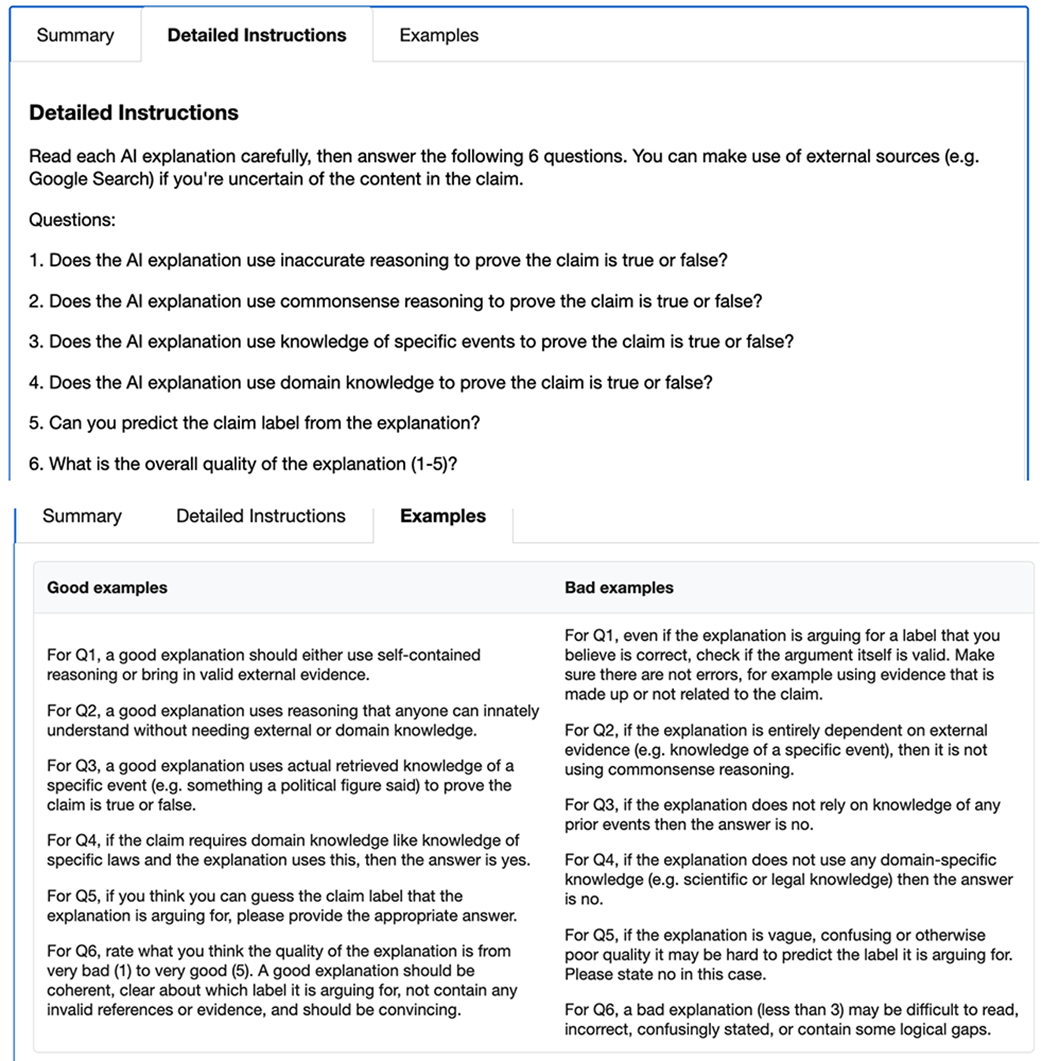
Use the annotation example to inspect how detailed instructions and illustrative examples help evaluators produce more consistent judgments. section 4.2.1
