Data annotation attaches labels to examples so a machine-learning system can learn or evaluate a target property. In an OCR workflow, annotators draw a bounding box around an ID number and enter the number manually. Fraud detection may require labeling transactions as fraudulent and asking domain experts to review existing data. section 1.1.1
Treat annotation as an operational stage in the data pipeline:
- Collect suitable raw or synthetic data, then determine which properties require labels. section 1.1.1
- Choose an annotation procedure appropriate to the modality: draw regions and transcribe text for document images, or classify transactions for fraud detection. section 1.1.1
- Organize labeled examples into training, validation, and test datasets. section 1.1.1
- Track annotation-related data changes because changing data can change model behavior and reproducibility. section 1.1.1
Annotating identity cards with CVAT
Use the Computer Vision Annotation Tool (CVAT), an open-source web-based image and video annotation tool, to mark regions on identity-card images. An ID-card detector can use a bounding box around the relevant document content, while procedurally generated synthetic images can avoid manual labeling when their images and labels are generated together. section 2.1.1 section 1.1.1
Figure 2.4 Example of an annotated ID card, shown in the CVAT web-based tool designed for annotating images and videos, which is commonly used to label data for computer vision models
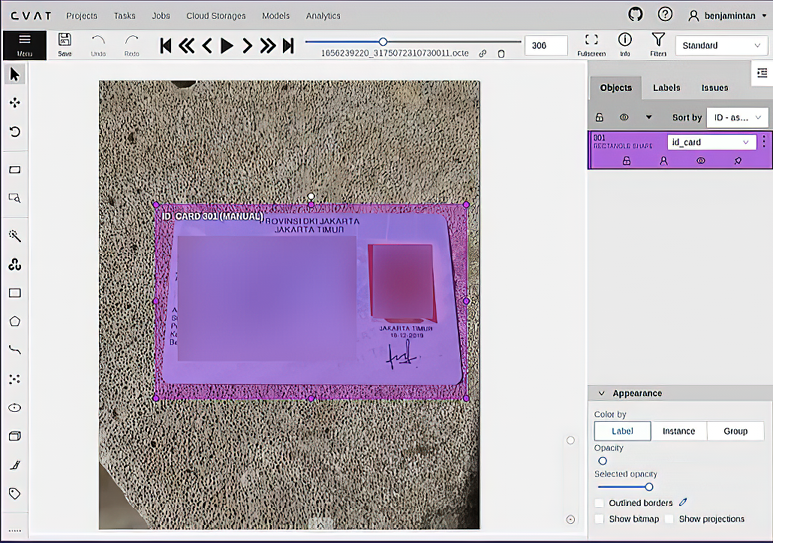
Inspect an annotated ID card in CVAT to connect the label format with the visual annotation task. section 2.1.1









