A human rights framework governs technology by starting with human dignity and fundamental rights rather than data, technology, commerce, or markets. It asks how systems affect people, especially when data collection is passive and algorithms are difficult to see or understand. section 3.14
This approach responds to limits in older privacy frameworks, which assumed explicit data collection and clear relationships between individuals and data collectors. It aims to confront systemic risks, rebalance power, and protect both information and individuals when consent alone cannot address opaque or boundary-crossing systems. section 3.14
The framework shifts governance toward:
- People as the starting point for technology regulation. section 3.14
- Protection against systemic harms that conventional consent mechanisms may miss. section 3.14
- A broader international consensus comparable to the role once played by fair information practice principles (FIPPs). section 3.14
Figure 3.4 A timeline of data protection laws
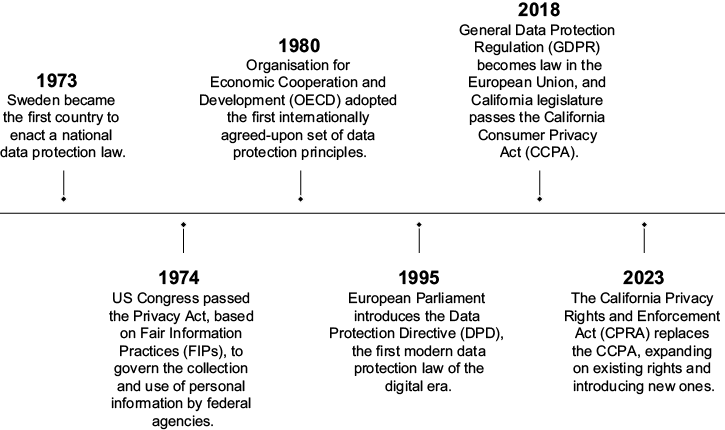
A timeline of data protection laws helps situate the framework within the evolution from database-era safeguards to broader privacy regulation. section 3.14
