A hybrid model combines smooth surface elements with triangle mesh elements in one representation, or switches between them as an operation requires. This balances precise geometry for manufacturing with fast processing and rendering for interactive applications. section 11.0 section 11.6
Figure 11.1 A torus described as a smooth surface (left) and as a triangle mesh of ~10,000 triangles (right)
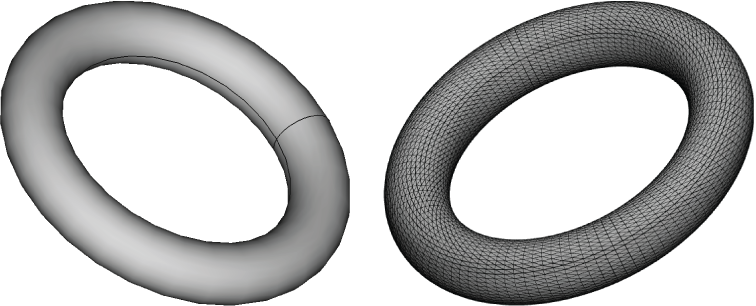
Compare a torus represented as a smooth surface with the same shape approximated by roughly 10,000 triangles. section 11.0
Choose the representation according to the practical task:
- Use triangle meshes when computational cost and rendering speed matter, such as in games, augmented reality, virtual reality, and computer-generated imagery. section 11.0 section 11.6
- Retain smooth surfaces when precise geometry matters, especially in computer-aided design and manufacturing workflows. section 11.0 section 11.6
3D printing
Traditional 3D printing relied heavily on triangle meshes, including STL files. Modern manufacturing-oriented workflows often preserve both triangles and smooth surfaces because printers and production processes now span curve-ready equipment and precise manufacturing data. section 11.0 section 11.6
