Hybrid search retrieves records through two paths at once: semantic vector matching and lexical text matching. A query is embedded for comparison with document vectors while its words or phrases are also sent to text search. The result set can merge and rank hits from both paths, rather than forcing retrieval to depend on only meaning similarity or only literal terms. section 3.2.7 section 4.2.2
This is useful in RAG when the goal is to supply the right text to a language model, not merely to find nearby vectors. Vector-only retrieval can miss correct context; keyword-only retrieval can miss differently phrased but equivalent requests. Combining them preserves exact-token matches while adding semantic understanding. section 3.0 section 3.2.7
A production-oriented hybrid search flow has these stages:
- Prepare searchable documents. Transform structured records into retrieval-oriented text, remove unnecessary characters, create embeddings, and retain useful metadata. section 3.4
- Index both text and vectors. Configure searchable fields, a correctly dimensioned vector field, and vector-search profiles that support text and vector queries. section 3.4
- Issue both query types. Pass the original query as text search and its generated embedding as a vector query, including the vector field and nearest-neighbor count. section 3.2.7 section 4.2.2
- Return a concise ranked result set. Hybrid retrieval merges results so exact wording and related meaning can both surface relevant records. section 3.2.7
- Keep the index current. Update changed records and remove deleted records when underlying data changes frequently. section 3.4
Finding a near-exact product title
For the query “Dubious parenting advice,” text search can find records containing the phrase or partial matches, while the query embedding searches nearby document vectors. Combining the two retrieves the “Dubious Parenting Tips” product record even though the stored title does not exactly repeat the query wording. section 3.2.7
For unstructured PDFs, index each extracted page as a document containing its raw text, embedding, and metadata such as publication date, file name, source URL, and page number. Because keyword search remains available, page-sized embeddings can be practical rather than requiring aggressive chunking. Image and video sources can similarly be represented by generated descriptions or transcripts plus embeddings and file links. section 3.3
Hybrid search is a document-retrieval tool, not a general aggregation engine. It can retrieve a product record but is not suited to summing values across a category. Use a SQL database for aggregated questions, or maintain search records containing commonly requested aggregate values. In agent-based retrieval, expose the hybrid function asynchronously so multiple sources can be searched without blocking. section 4.2.2
Figure 4.7 Illustrates the workflow for handling search queries using Azure AI Search. Queries are converted into vector embeddings, enabling a hybrid (text and vector) search to efficiently retrieve the most relevant documents for the user.
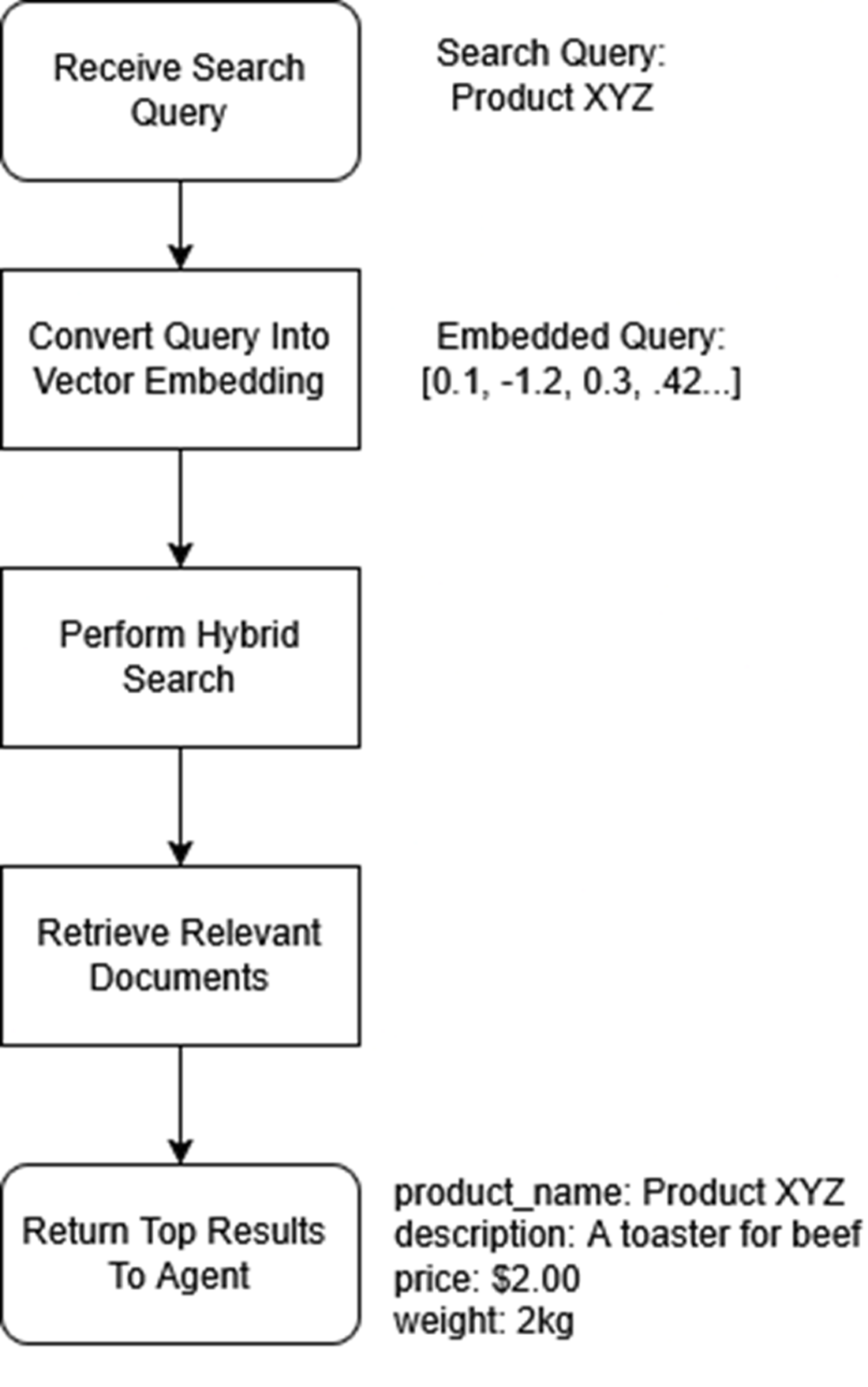
This workflow diagram shows the operational handoff from a user query to its embedding, then to combined text and vector retrieval in Azure AI Search. section 4.2.2














