A hybrid storage model combines cloud and on-premises environments in one data platform. It keeps selected datasets locally for latency, cost, sovereignty, or compliance while using cloud storage for analytics, elasticity, or long-term retention. section 4.3.1
Design requirements should make the boundary between environments explicit:
- Expose a consistent object-store interface across cloud and on-premises systems. section 4.3.1
- Provide unified metadata and catalog integration across heterogeneous storage backends. section 4.3.1
- Specify access controls, auditability, encryption, retention, network isolation, and capacity-management responsibilities. section 4.3.1
- Expect greater monitoring, troubleshooting, and operational complexity than a fully cloud or fully on-premises design. section 4.3.1
Banking lakehouse deployment
Hamerliva Bank uses Amazon S3 for elastic cloud analytics and MinIO clusters in European and US data centers for residency, air-gapped operation, and encrypted storage at rest. Both environments support its Iceberg lakehouse. section 4.5.1
Figure 4.6 The Hamerliva Bank architectural proposal shows how the components relate to one another.
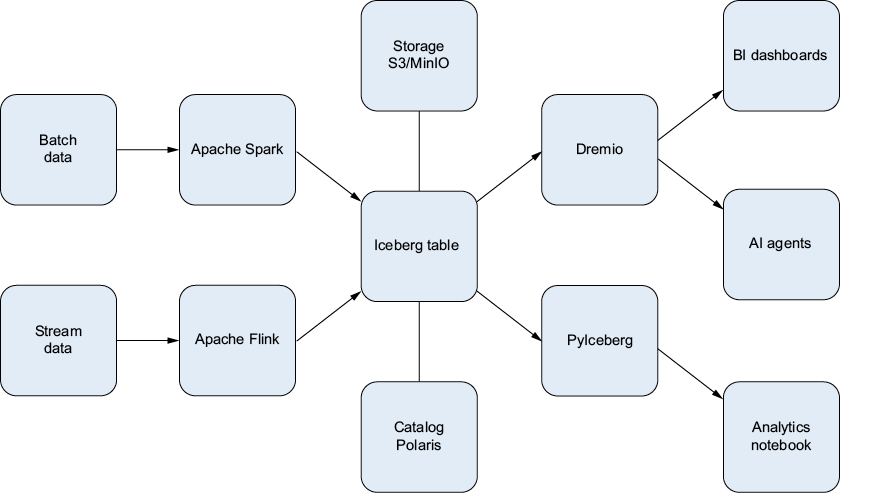
Use the architectural proposal to trace how hybrid storage connects with ingestion, catalogs, compute, governance, and analytics components. section 4.5.1
