A hybrid topology combines two or more different network topology patterns. It describes the mixed arrangements found in most practical networks, rather than a single connection pattern. section 15.5 section 15.1
Recognize hybrid designs by the component patterns they combine:
- Star: end devices connect to a central device, commonly a switch in a LAN. section 15.5
- Full mesh: every device connects directly to every other device. section 15.1
- Partial mesh: selected devices connect directly, but not every device connects to every other device. section 15.1
- Campus LANs commonly combine these patterns across access, distribution, and optionally core layers. section 15.5
Figure 15.1 Common topologies. In a star topology, all devices connect to a central device. In a full mesh, each device is directly connected to each of the other devices. In a partial mesh, only certain devices are directly connected.
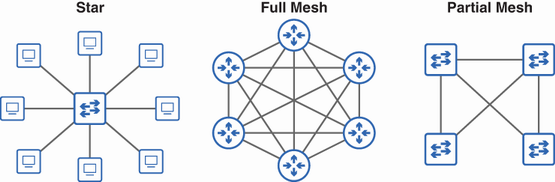
Compare star, full-mesh, and partial-mesh arrangements visually before identifying their combination as a hybrid topology. section 15.1
