A hydrophobic core is the water-excluding interior of a folded protein, formed when nonpolar sidechains cluster away from the aqueous environment. This hydrophobic effect helps drive tertiary structure: distant sequence regions come together, while backbone hydrogen bonds in alpha-helices and beta-sheets satisfy buried polar groups. section 12.1.1
The core connects several structural and modeling ideas:
- Hydrophobic residues minimize unfavorable water contact by packing inward. section 12.1.1
- Secondary structures help satisfy backbone hydrogen-bonding requirements after collapse. section 12.1.1
- Structure-prediction models must capture long-range contacts that assemble and pack the core. section 12.1.1
Figure 12.3 Primary structure is the linear sequence of amino acids. Secondary structure is local backbone geometry—chiefly alpha-helices and beta-strands—stabilized largely by backbone hydrogen bonding. Tertiary structure is the full three-dimensional arrangement of a single polypeptide chain, including how its secondary-structure elements and connecting loops pack together. Quaternary structure describes an assembly of more than one chain.
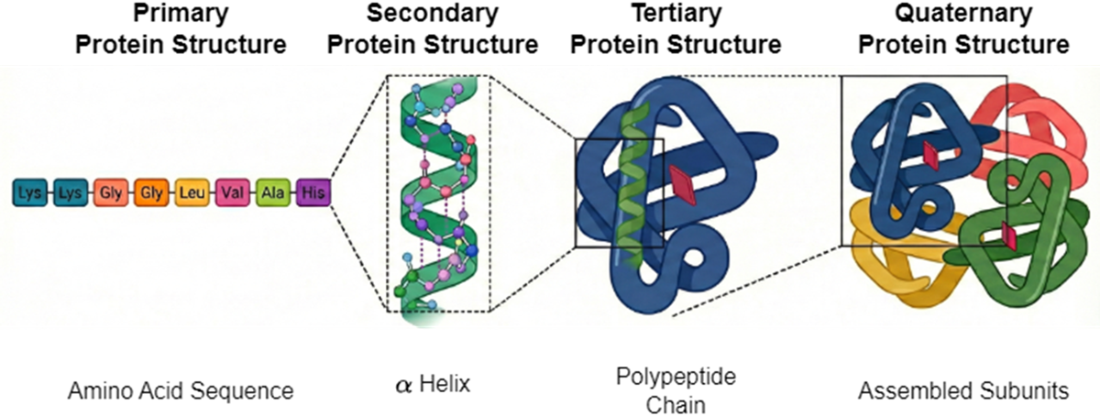
Use the structural hierarchy to place hydrophobic-core packing within tertiary structure, alongside primary and secondary structure. section 12.1.1
