Hydrophobicity describes a chemical group’s or molecule’s tendency to favor a nonpolar environment over an aqueous one. In proteins, hydrophobicity helps explain why aliphatic and aromatic residues commonly occupy buried cores and binding pockets, where they can contact nonpolar drug regions. section 11.3.2
Classifies amino-acid side chains using related chemical properties:
- Aliphatic residues—alanine, isoleucine, leucine, methionine, and valine—are nonpolar and non-aromatic. section 11.3.2
- Aromatic residues—phenylalanine, tryptophan, and tyrosine—are hydrophobic and may also support π-π stacking with ligand aromatic rings. section 11.3.2
- Polar, acidic, and basic residues are generally more hydrophilic and commonly occur on protein surfaces. section 11.3.2
Figure 11.6 Chemical Diversity of Amino Acid Side Chains. The figure displays five amino acids, each representing one of the major chemical classes. From left to right: Alanine, an aliphatic amino acid with a simple methyl side chain; Phenylalanine, an aromatic amino acid containing a phenyl group; Serine, a polar neutral amino acid with a hydroxyl group; Aspartic Acid, an acidic amino acid with a carboxyl group; and Lysine, a basic amino acid with an amino group. These diverse side chains are fundamental to determining protein structure and its interactions with other molecules.
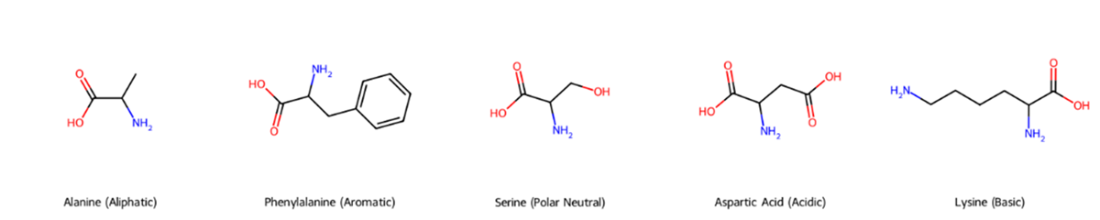
Compare representative side chains—alanine, phenylalanine, serine, aspartic acid, and lysine—to see how chemical classes differ. section 11.3.2
