Hyperopt is a lightweight Python library for automating hyperparameter optimization in small or early-stage model-training projects. It supports serial and parallel searches, reducing impractical manual tuning across choices such as learning rate, batch size, epochs, and model structure. section 5.0 section 5.4.1
A basic Hyperopt experiment has three implementation steps:
- Define an objective function that receives sampled hyperparameters, trains a model, evaluates it, and returns a numeric score. section 5.4
- Declare a search space, including conditional choices and parameter distributions for each candidate model configuration. section 5.4.1
- Call the optimization routine with the objective, search space, selected algorithm, and trial limit. section 5.4.1
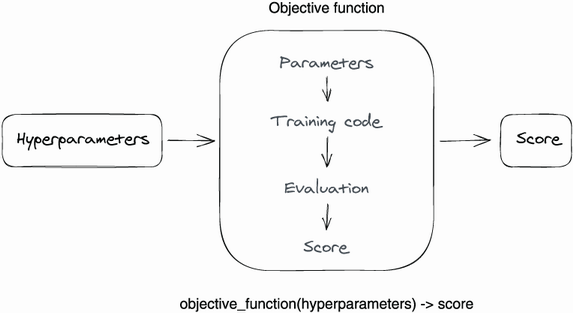
Use the objective-function diagram to trace how sampled hyperparameters enter training and become the score returned to the search algorithm. section 5.4
Classifier search
A practical experiment can compare naive Bayes, SVM, and decision trees. The search space gives SVM-specific values for C and kernel width, while decision trees vary criterion and maximum depth. TPE can optimize the space for ten trials. section 5.4.1
Listing 5.1 Getting started with Hyperopt
# Step 1: define an objective function
def objective(args):
  model = train(args)                                   #1
  return evaluate(model)                                #1

# Step 2 define search space for hyperparameters
space = hp.choice('classifier_type', [                  #2
  {
    'type': 'naive_bayes',
  },
  {
    'type': 'svm',
    'C': hp.lognormal('svm_C', 0, 1),                   #3
    'kernel': hp.choice('svm_kernel', [                 #3
      {'ktype': 'linear'},                              #3
      {'ktype': 'RBF',                                  #3
       'width': hp.lognormal('svm_rbf_width', 0, 1)},   #3
    ]),
  },
  {
    'type': 'dtree',
    'criterion': hp.choice('dtree_criterion',
      ['gini', 'entropy']),
    'max_depth': hp.choice('dtree_max_depth',
      [None, hp.qlognormal('dtree_max_depth_int', 3, 1, 1)]),
    'min_samples_split': hp.qlognormal(
      'dtree_min_samples_split', 2, 1, 1),
  },
  ])

#Step 3 start the hpo process execution
best = fmin(objective, space, algo=tpe.suggest,
  max_evals=100)                            #4
Use the starter listing as a runnable reference for wrapping training, defining conditional hyperparameter spaces, and invoking Hyperopt. section 5.4.1
For larger runs, distribute Hyperopt workers across machines through a central coordination database or use Spark for parallel execution. section 5.4.1
