A hyperparameter search space defines the values an optimization process may try while training a model. Rather than manually tweaking empirical settings, define candidate values or ranges, run trials, record evaluation results, and select the configuration that produces the best objective value. For learning rate and batch size, two six-value sets create 36 candidate pairs. section 5.2.1
Search spaces can combine discrete choices, continuous ranges, categorical options, and conditional values. Their size and structure directly affect cost: exhaustive evaluation becomes impractical as the number of hyperparameters or candidate values grows, while deep learning configurations can be high-dimensional and conditional. section 5.2.1 section 5.2.2
Choose a representation that fits the search algorithm and the training decision:
- Use finite sets for grid search. The algorithm forms the Cartesian product of each hyperparameter’s allowed values and evaluates the resulting configurations. section 5.2.2
- Use numeric intervals with a trial budget for random search. Each trial samples a value from each range until the budget is exhausted. section 5.2.2
- Use conditional branches when one choice enables its own parameters, such as classifier-specific SVM, decision-tree, or kernel settings. section 5.4.1
- Keep the search space separate from training code so an HPO service can support arbitrary frameworks, languages, and interchangeable search algorithms. section 5.3.1 section 5.3.2
Conditional classifier space
A classifier choice can include naive Bayes, SVM, and decision tree. Selecting SVM exposes parameters such as C, kernel type, and an RBF width drawn from a lognormal distribution; selecting a decision tree exposes criterion and maximum depth instead. This prevents trials from assigning irrelevant parameters to a chosen classifier. section 5.4.1
In a service workflow, submit training code, the hyperparameters and their value search spaces, an objective, and an HPO algorithm. A suggestion component selects a configuration; a job manager launches the trial and collects metrics, accuracy, progress, and tried values. This separation lets the service add algorithms without changing the user-facing experiment structure. section 5.3.2 section 5.3.1
Defining spaces in Python HPO tools
Optuna defines the space inside an objective function with categorical, floating-point, and integer suggestions, then trains and evaluates the sampled model. Ray Tune instead passes a search-space configuration to the training function; a learning rate may be sampled from a function and momentum uniformly from 0.1 to 0.9. Both patterns connect sampled values to an objective score. section 5.4.2 section 5.4.3
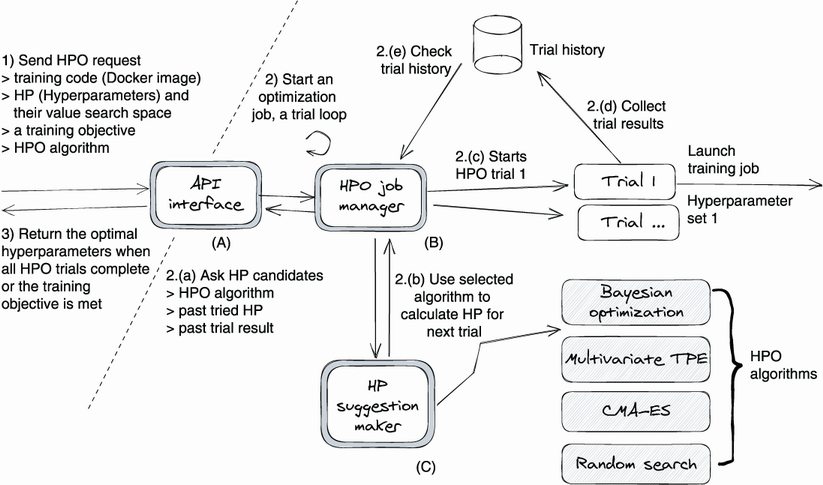
This architecture locates the submitted search space between the API interface, algorithm adapter, and trial-execution manager. section 5.3.2

