A narrow column can leave a line too short or force large, ugly gaps between words. Hyphenation offers another choice: divide a word at an acceptable point at the line boundary, mark the division with a hyphen, and continue the rest on the next line. It is one of the small adjustments used to make a paragraph fit while keeping its texture readable. section 10.0 section 10.1
Figure 10.6 Hyphenation by preference (left) and spacing by preference (right)
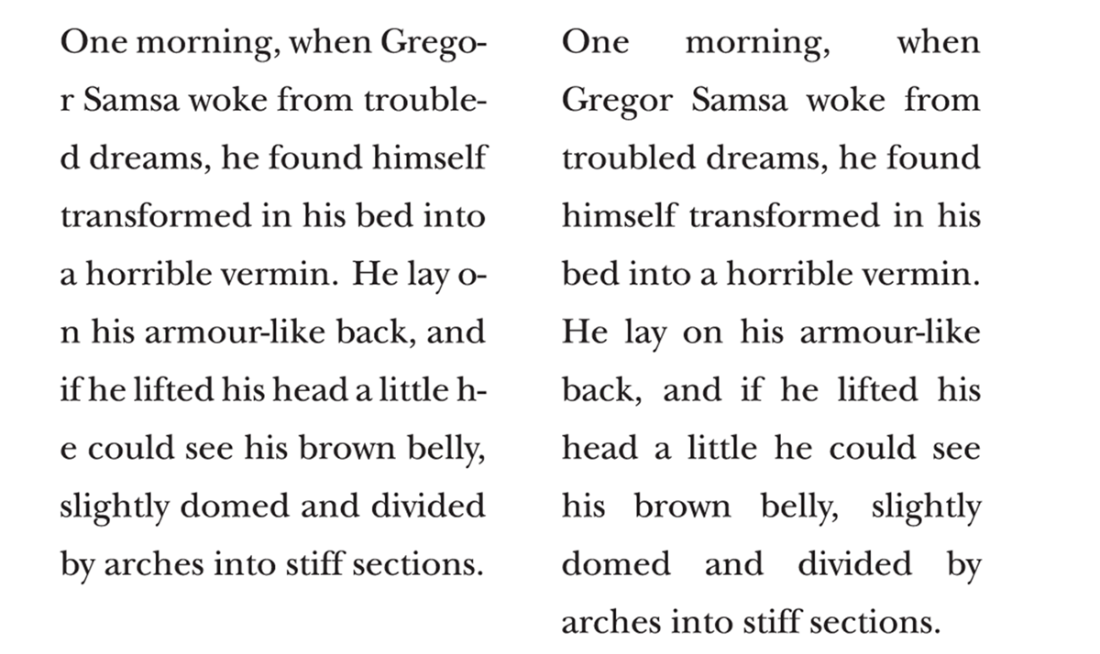
Compare two priorities in the same paragraph: breaking words whenever a line fills, or adjusting word spaces first and hyphenating only when needed. The contrast makes clear why a permitted break is not automatically a good-looking break. section 10.2
Not every position inside a word is equally suitable. Breaks such as trouble-d, o-n, and h-e look awkward, while trou-bled and on are preferable. Meaning can matter too: rec-ord may suit the noun, whereas re-cord may suit the verb. Dictionaries can disagree about acceptable divisions, and some words, such as squirm, may have no good division at all. section 10.2
Automatic hyphenation can choose candidate breaks in two main ways:
- A dictionary-based system stores words together with their permitted hyphenation points. It gives perfect results for known words but cannot help with an unfamiliar technical term or proper name. section 10.2
- A rule-based system applies patterns for good and bad breaks, such as allowing a break after q before a vowel, permitting one before -ness, or forbidding b-ly. Rules may apply anywhere or only at a word’s beginning or end, and can be derived from known correct hyphenations. section 10.2
Choosing a compromise
Suppose a justified line contains armour-like in a very narrow column. Rather than stretch the letters of the compound word, a compositor may leave the line under-full. A wider column needs fewer compromises and can sometimes avoid hyphens entirely. Hyphenation therefore works alongside column width and word spacing, not as a mechanical command to split every word that reaches the margin. section 10.1
The decision once had a physical cost. Hand composition required inserting exact spaces and hyphenating each line in a galley of metal type; a correction after proof printing could mean taking apart and resetting much more than one character. Mechanical and later computer systems automated line justification, but the underlying problem remains a balance of calculation and taste. section 10.4 section 10.6
Practice: find plausible break points
Try marking good division points in hyphenation, fundraising, arithmetic as a noun and adjective, demonstration, demonstrative, genuine, and mountainous. Then ask whether each proposed break preserves a natural-looking word and whether the line could instead be improved by changing space between words. section 10.5 section 10.2
