liveBook · Manning

Idempotency guard

As explained in Crack Any Codebase with AI

An idempotency guard prevents repeated processing of the same logical request from creating duplicate state changes.

An idempotency guard ensures that retrying the same logical POST does not create duplicate database state. Place it inside the atomic critical section, typically by storing an idempotency key in a column with a UNIQUE constraint. section 8.4

Retrying a POST

A request passes validation and enters BEGIN ... COMMIT. The handler checks the idempotency key while performing conflict checks and writes. If the client retries the POST, the UNIQUE constraint prevents a second row, while the small transaction limits the lock window. section 8.4

Figure 8.6 A typical API request has three phases: synchronous pre-flight checks the user waits for, a core database transaction, and asynchronous follow-up work that runs after the 201 response is sent.
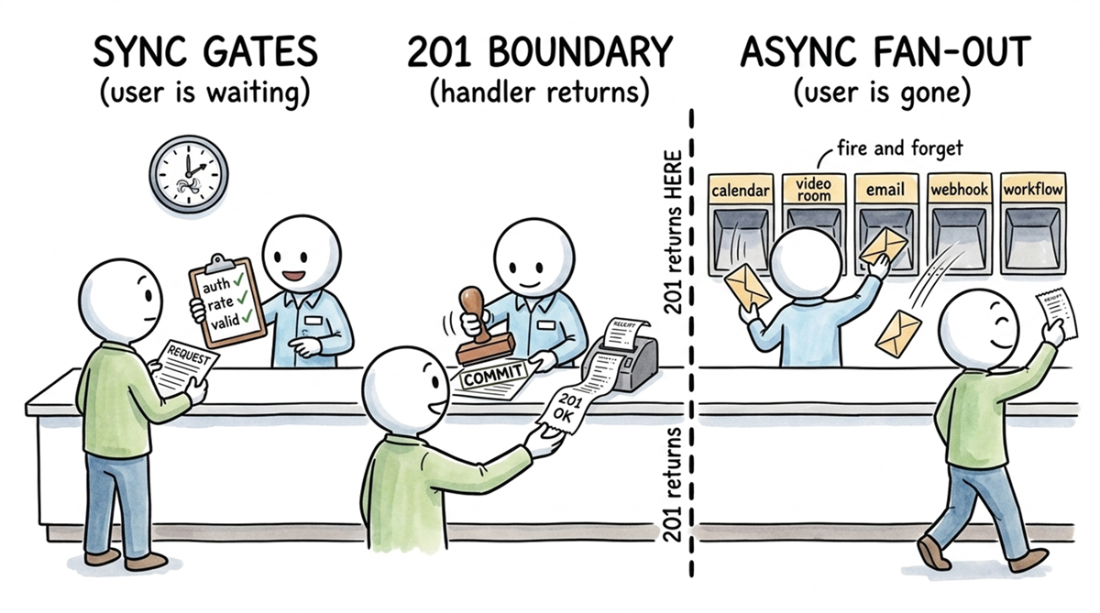
Use the three-phase request flow to locate the guard: after pre-flight validation and inside the core database transaction, before asynchronous follow-up work. section 8.4

How Crack Any Codebase with AI covers it

How deep it goes
Defines a UNIQUE idempotency-key column and places it within an atomic transaction, but does not detail handler implementation.
Examples
Uses a retried POST, an idempotency_key column, a UNIQUE constraint, and a BEGIN ... COMMIT critical section.
What it assumes
Assumes familiarity with API requests, database rows, UNIQUE constraints, and atomic transactions.
What you can do after
Build it from scratch by placing a unique idempotency key inside the core database transaction.
How it connects
Connects idempotency guards to database transactions, conflict checks, optimistic locking, pessimistic locking, and asynchronous fan-out.

Related concepts

This explainer was generated by Manning's knowledge graph from the text of Crack Any Codebase with AI. The section links point to the parts of the book it draws on.