An idempotency key identifies one logical operation across repeated attempts. When a client double-clicks Confirm or retries a stalled POST, the server recognizes the repeat and returns the existing result instead of creating another effect. section 8.5
The key is usually protected by a database UNIQUE constraint. In the booking flow, the server deterministically hashes startTime, endTime, and userId into a uuidv5. Identical requests calculate the same key; the first insert succeeds, while the second is converted into a response for the existing booking. section 8.5
One booking from two Confirm clicks
Two requests arrive with the same idempotencyKey. The database accepts the first INSERT and rejects the second duplicate key. The handler returns the original booking, preventing a duplicate booking or double charge. section 8.5
Inspect an idempotency design by asking:
- Where is the duplicate-write guard: a key, a lock, or a constraint? section 8.5
- Does the guard run inside the atomic database transaction with conflict checks and the core write? section 8.4
- Which external calls need their own keys? A Stripe refund can be issued twice when a retry follows a network timeout. section 7.5
Figure 8.8 A double-clicked "Confirm" sends two requests with the same idempotencyKey. A UNIQUE constraint lets the first INSERT succeed but rejects the second, creating one booking instead of a double charge.
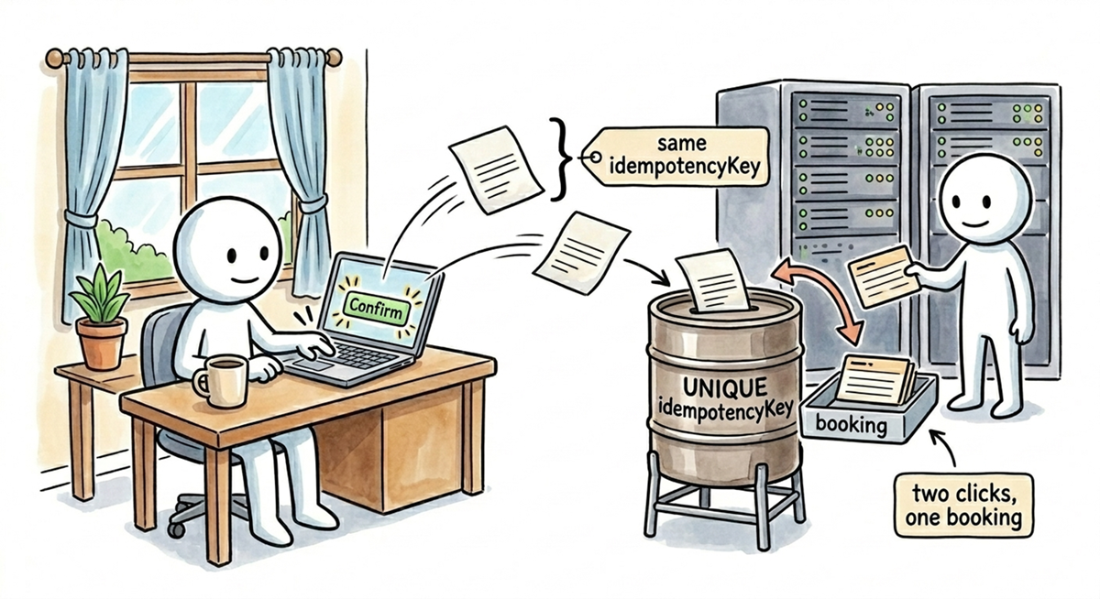
Follow the two-request sequence to see how one shared idempotencyKey and a UNIQUE constraint turn a double submission into one booking. section 8.5



