IID means observations are sampled independently and follow the same probability distribution. Each observation neither influences nor carries information about the next, and every observation comes from the same kind of data-generating process. section 2.1.1
For tabular modeling, IID data supports random sampling and randomly creating cross-validation folds. The assumption does not fit grouped, repeated, hierarchical, or time-dependent data, where related observations can share information. section 2.1.1
Coin flips and grouped sales
Repeated flips of the same coin provide an IID dataset: each result is independent, and heads or tails follow the same Bernoulli distribution. Sales from multiple stores are non-IID when observations from one store are correlated, while school classes can share distinctive characteristics. section 2.1.1
Figure 2.1 Comparison of IID and non--IID data sequences. The left chart shows IID data, while the right chart illustrates non-IID data, highlighting the sequential correlation patterns.
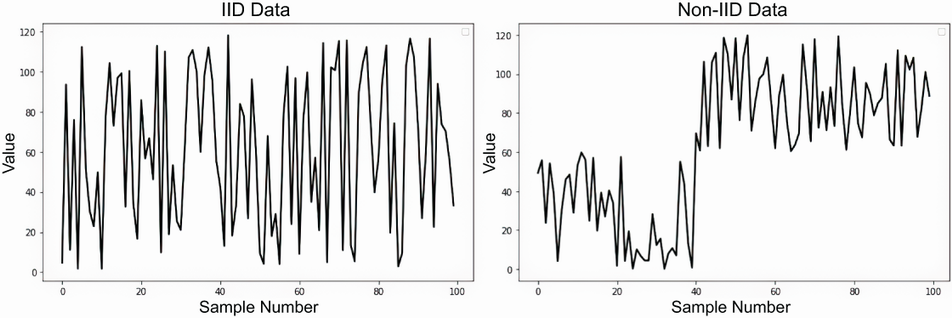
Compare an IID sequence with a non-IID sequence to see how sequential correlation breaks the independence assumption. section 2.1.1


